Select Item below to DOWNLOAD - Once item is selected, right click and choose 'save as'


fcbd304a-4fcb-407d-9801-02e291f6de33
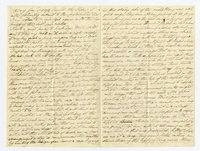
Frances (Appleton) Longfellow to Mary (Mackintosh) Rich, 20 August 1841
Manuscript letter
St Leonard’s. Aug 20th 1841.
My dear, dear Mrs Rich,
We have just arrived at this sea-side place so I take immediate advantage of a pause in our pilgrimage to acquaint you of our late doings & to thank you from my heart for your kind wish to hear from me.
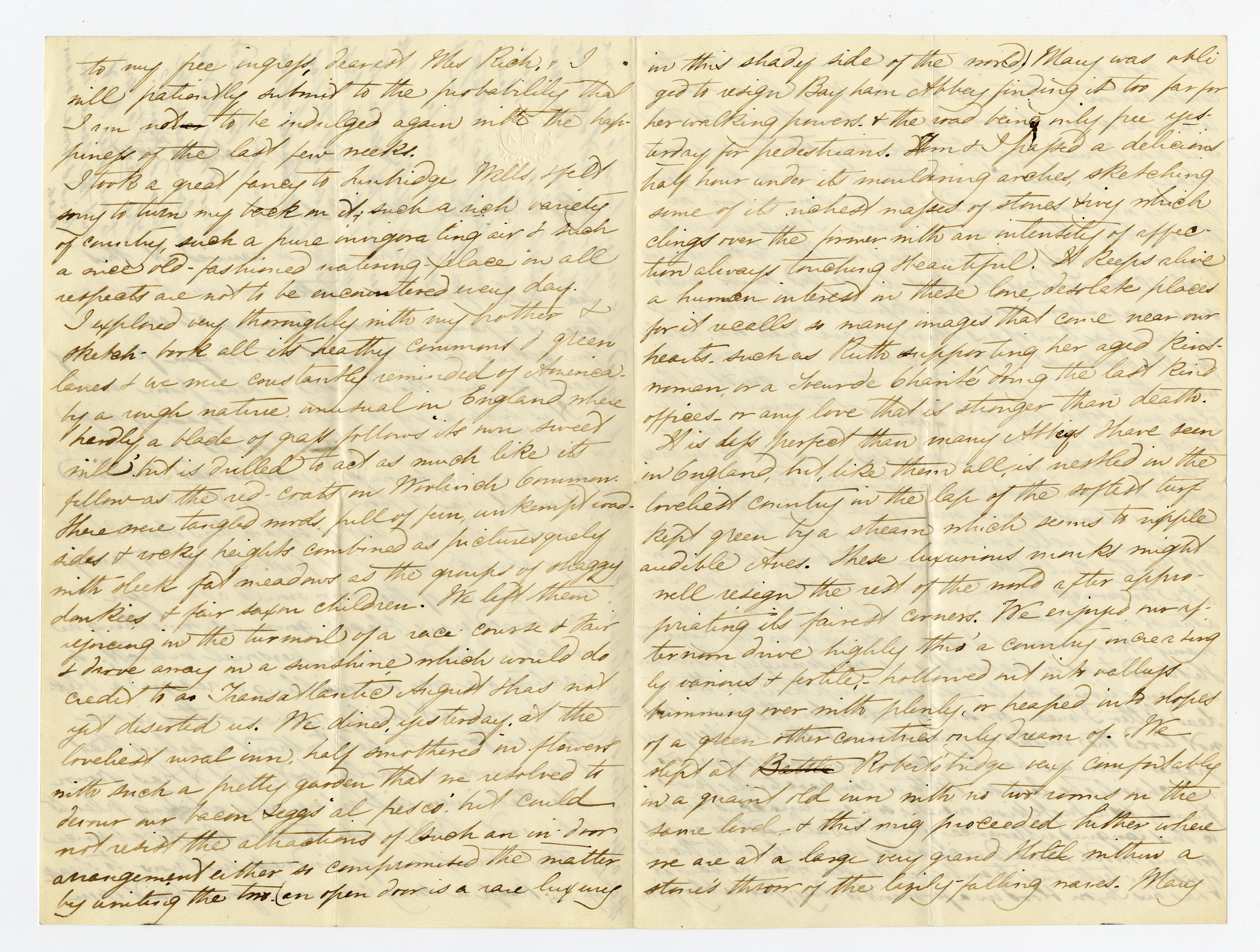
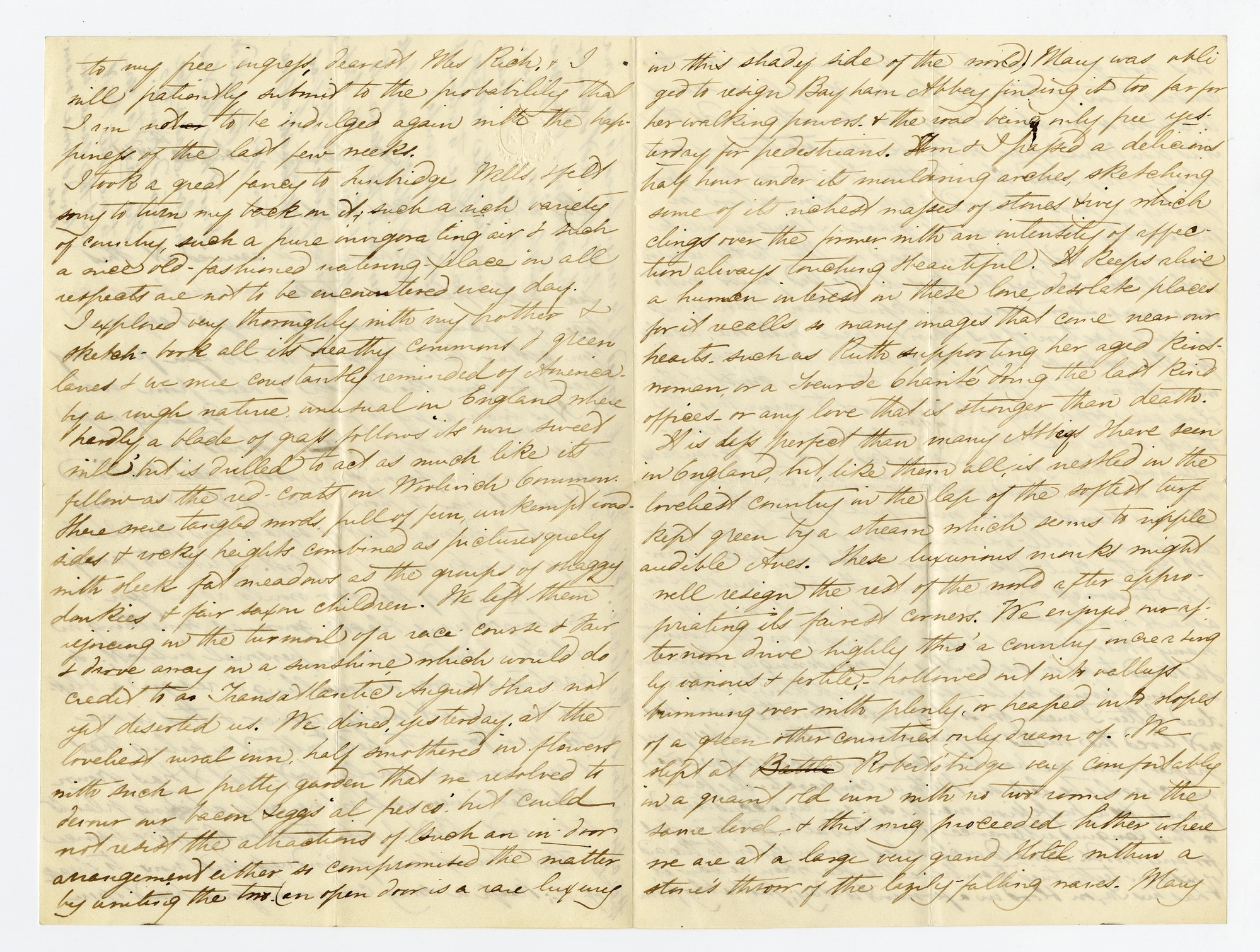
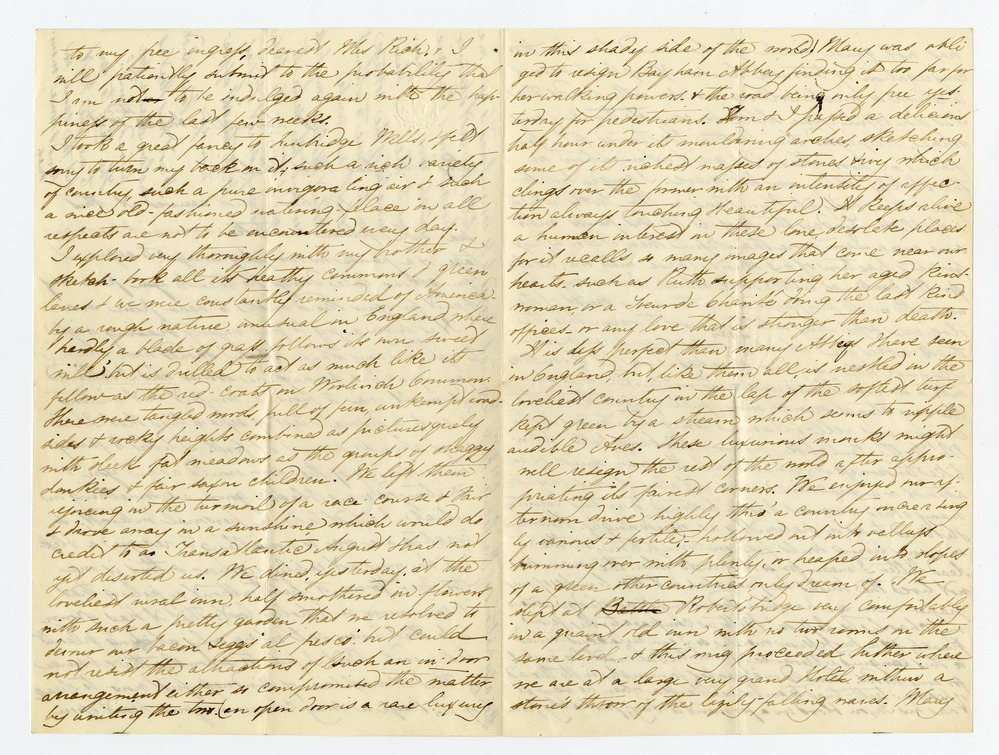
It is such a joy to find myself drawing night to you again in any shape! [crossed out: that] I should have claimed your gracious permission sooner had I believed it [crossed out: would] was to prove a comfort but writing is such a dismal test of separation that I always shrink from it at first. I liked to fancy every opening of the door would admit you & scrutinized every black gown as something in which I must take a personal interest; so exacting are we, so unwilling to resign a blessing we may not easily recover - & this is one too dear for me to yield it without a feeling that it can never be wholly lost, - that it has grown into that inner soil where only abiding plants take root. But I feel too seriously the absence of that atmosphere of kindness just now to speak of it -; keep a snug corner in your heart open [p. 2] to my free ingress, dearest Mrs Rich, & I will patiently submit to the probability that I am [crossed out: never] not to be indulged again with the happiness of the last few weeks.
I took a great fancy to Tunbridge Wells, & felt sorry to turn my back on it, such a rich variety of country, such a pure invigorating air & such a nice old-fashioned watering-place in all respects are not to be encountered every day. I explored very thoroughly with my brother & sketch-book all its heathy commons & green lanes & we were constantly reminded of America – by a rough nature, unusual in England where hardly a blade of grass follows ‘its own sweet will’ but is drilled to act as much like its fellow as the red-coats on Woolwich Common. There were tangled woods, full of fern, unkept roadsides & rocky heights combined as picturesquely with sleek fat meadows as the groups of shaggy donkies & fair saxon children. We left them rejoicing in the turmoil of a race-course & Fair & drove away in a sunshine which would do credit to a Transatlantic August & has not yet deserted us. We dined, yesterday, at the loveliest rural inn, half smothered in flowers with such a pretty garden that we resolved to devour our bacon & eggs ‘al fresco,’ but could not resist the attractions of such an in-door arrangement either so compromised the matter by uniting the two. (an open door is a rare luxury [p. 3] in this shady side of the world.) Mary was obliged to resign Bayham Abbey finding it too far for her walking powers. & the road being only free yesterday for pedestrians. Tom & I passed a delicious half hour under its mouldering arches, sketching some of its richest masses of stones & ivy which clings over the former with an intensity of affectation always touching & beautiful. It keeps alive a human interest in these lone, desolate places, for it recalls so many images that came near our hearts – such as Ruth supporting her aged kinswoman, or a Soeur de Charité doing the last kind offices – or any love that is stronger than death. It is less perfect than many Abbeys I have seen in England, but, like them all, is nestled in the loveliest country in the lap of the softest turf kept green by a stream which seems to ripple audible Aves. These luxurious monks might well resign the rest of the world after appropriating its fairest corners. We enjoyed our afternoon drive highly thro’ a country increasingly various & fertile, - hollowed out into valleys brimming over with plenty, or heaped into slopes of a green other countries only dream of. We slept at [crossed out: Battle] Robert’s bridge very comfortably in a quaint old inn with no two rooms on the same level, & this mn’g proceeded hither where we are at a large very grand Hotel within a stone’s throw of the lazily-falling waves. Mary [p. 4] has not quite made up her mind to like the congregation of townish houses & people & seems to relish so much rolling over smooth roads that it is doubtful if we shall be very stationary any where. We passed thro’ Battle & bestowed fit sympathy on poor Harold & great admiration on the stately Abbey over his grave. I congratulate you & every body at Plumstead on Mr Scott’s return & shall, on Sunday, think of its blessed fruits with some envy. I am more thankful than I can express for every fraction of his spirit I have with me, as also for Mr Erskine’s little book which has enough living truth in its few pages to scatter every mist of theological sophistry into thin air & to warm thro’ the “thick-ribbed ice” which so often encases man’s religion – I cannot tell you how shocked I was at Seven Oaks with a sermon I heard under its noble old church. The very stones seemed more full of life than the clergyman’s well-balanced tones & sentences & after Mr Scott’s Paul-like fervor & Mr Campbell’s John-like tenderness it seemed to me the man must be an atheist or a machine. And yet alas, it was very like many other sermons I have listened to in this country & listened to as impatiently as wonderingly. How can so many living souls feed on corruption? on the dead letter, I mean, for it so sounds when the man has not lived the truths he preaches – but the limits of my paper warn we how limited is my knowledge – may my charity be less so! With us comparatively few preach, for a profession merely, so I am unaccustomed to this languid utterance of realities almost too awful for any words. Ronald vociferates famously with the aid of his new teeth; tried to embrace the sea when he saw it, & has his Saxon blood in a ferment to-day; probably from [p. 1 cross] the associations of the ‘locale’! Miss Sedgwick begged to be remembered to you in a letter the last steamer brought me. Pray give much love from me to the dear inmates of the cottage on the lane to whom I shall soon write.
Robert, Molly & my brother send the same to you & them. The Babes many sweet kisses –
With much affection yr
Fanny E.A.
Is not this heat as welcome as a foe turned friend? The East to you, to me the West but the same in kind & home – memories.
My dear, dear Mrs Rich,
We have just arrived at this sea-side place so I take immediate advantage of a pause in our pilgrimage to acquaint you of our late doings & to thank you from my heart for your kind wish to hear from me.
It is such a joy to find myself drawing night to you again in any shape! [crossed out: that] I should have claimed your gracious permission sooner had I believed it [crossed out: would] was to prove a comfort but writing is such a dismal test of separation that I always shrink from it at first. I liked to fancy every opening of the door would admit you & scrutinized every black gown as something in which I must take a personal interest; so exacting are we, so unwilling to resign a blessing we may not easily recover - & this is one too dear for me to yield it without a feeling that it can never be wholly lost, - that it has grown into that inner soil where only abiding plants take root. But I feel too seriously the absence of that atmosphere of kindness just now to speak of it -; keep a snug corner in your heart open [p. 2] to my free ingress, dearest Mrs Rich, & I will patiently submit to the probability that I am [crossed out: never] not to be indulged again with the happiness of the last few weeks.
I took a great fancy to Tunbridge Wells, & felt sorry to turn my back on it, such a rich variety of country, such a pure invigorating air & such a nice old-fashioned watering-place in all respects are not to be encountered every day. I explored very thoroughly with my brother & sketch-book all its heathy commons & green lanes & we were constantly reminded of America – by a rough nature, unusual in England where hardly a blade of grass follows ‘its own sweet will’ but is drilled to act as much like its fellow as the red-coats on Woolwich Common. There were tangled woods, full of fern, unkept roadsides & rocky heights combined as picturesquely with sleek fat meadows as the groups of shaggy donkies & fair saxon children. We left them rejoicing in the turmoil of a race-course & Fair & drove away in a sunshine which would do credit to a Transatlantic August & has not yet deserted us. We dined, yesterday, at the loveliest rural inn, half smothered in flowers with such a pretty garden that we resolved to devour our bacon & eggs ‘al fresco,’ but could not resist the attractions of such an in-door arrangement either so compromised the matter by uniting the two. (an open door is a rare luxury [p. 3] in this shady side of the world.) Mary was obliged to resign Bayham Abbey finding it too far for her walking powers. & the road being only free yesterday for pedestrians. Tom & I passed a delicious half hour under its mouldering arches, sketching some of its richest masses of stones & ivy which clings over the former with an intensity of affectation always touching & beautiful. It keeps alive a human interest in these lone, desolate places, for it recalls so many images that came near our hearts – such as Ruth supporting her aged kinswoman, or a Soeur de Charité doing the last kind offices – or any love that is stronger than death. It is less perfect than many Abbeys I have seen in England, but, like them all, is nestled in the loveliest country in the lap of the softest turf kept green by a stream which seems to ripple audible Aves. These luxurious monks might well resign the rest of the world after appropriating its fairest corners. We enjoyed our afternoon drive highly thro’ a country increasingly various & fertile, - hollowed out into valleys brimming over with plenty, or heaped into slopes of a green other countries only dream of. We slept at [crossed out: Battle] Robert’s bridge very comfortably in a quaint old inn with no two rooms on the same level, & this mn’g proceeded hither where we are at a large very grand Hotel within a stone’s throw of the lazily-falling waves. Mary [p. 4] has not quite made up her mind to like the congregation of townish houses & people & seems to relish so much rolling over smooth roads that it is doubtful if we shall be very stationary any where. We passed thro’ Battle & bestowed fit sympathy on poor Harold & great admiration on the stately Abbey over his grave. I congratulate you & every body at Plumstead on Mr Scott’s return & shall, on Sunday, think of its blessed fruits with some envy. I am more thankful than I can express for every fraction of his spirit I have with me, as also for Mr Erskine’s little book which has enough living truth in its few pages to scatter every mist of theological sophistry into thin air & to warm thro’ the “thick-ribbed ice” which so often encases man’s religion – I cannot tell you how shocked I was at Seven Oaks with a sermon I heard under its noble old church. The very stones seemed more full of life than the clergyman’s well-balanced tones & sentences & after Mr Scott’s Paul-like fervor & Mr Campbell’s John-like tenderness it seemed to me the man must be an atheist or a machine. And yet alas, it was very like many other sermons I have listened to in this country & listened to as impatiently as wonderingly. How can so many living souls feed on corruption? on the dead letter, I mean, for it so sounds when the man has not lived the truths he preaches – but the limits of my paper warn we how limited is my knowledge – may my charity be less so! With us comparatively few preach, for a profession merely, so I am unaccustomed to this languid utterance of realities almost too awful for any words. Ronald vociferates famously with the aid of his new teeth; tried to embrace the sea when he saw it, & has his Saxon blood in a ferment to-day; probably from [p. 1 cross] the associations of the ‘locale’! Miss Sedgwick begged to be remembered to you in a letter the last steamer brought me. Pray give much love from me to the dear inmates of the cottage on the lane to whom I shall soon write.
Robert, Molly & my brother send the same to you & them. The Babes many sweet kisses –
With much affection yr
Fanny E.A.
Is not this heat as welcome as a foe turned friend? The East to you, to me the West but the same in kind & home – memories.
Archives Number: 1011/002.001-011#020
U. S. National Park Service
Permission must be secured from the individual copyright owners to reproduce any copyrighted materials contained within this website.
Courtesy of National Park Service, Longfellow House-Washington's Headquarters National Historic Site; Archives Number 1011/002.001-011#020
Public domain
Correspondence (1011/002), (LONG-SeriesName)
, Letters from Frances Longfellow (1011/002.001), (LONG-SubseriesName)
, 1841 (1011/002.001-011), (LONG-FileUnitName)
, Letters from Frances Longfellow (1011/002.001), (LONG-SubseriesName)
, 1841 (1011/002.001-011), (LONG-FileUnitName)
Image
Longfellow House - Washington's Headquarters National Historic Site, Code: LONG
Longfellow House - Washington's Headquarters National Historic Site, Middlesex County, Massachusetts
Latitude: 42.3769989013672, Longitude: -71.1264038085938
Latitude: 42.3769989013672, Longitude: -71.1264038085938
NPS Museum Number Catalog : LONG 20257
Title: Finding Aid to the Frances Elizabeth Appleton Longfellow (1817-1861) Papers, 1825-1961 (bulk dated: 1832-1861)
URL: https://www.nps.gov/long/learn/historyculture/archives.htm#FEAL
URL: https://www.nps.gov/long/learn/historyculture/archives.htm#FEAL
2021-06-16
08/20/1841
Manuscript letter in Frances Appleton Longfellow Papers, Series II. Correspondence, A. Outgoing, 1841. (1011/002.001-011#020)
Public Can View
Organization: Longfellow House-Washington's Headquarters National Historic Site
Address: 105 Brattle Street, Cambridge, MA 02138
Email: LONG_archives@nps.gov
Address: 105 Brattle Street, Cambridge, MA 02138
Email: LONG_archives@nps.gov
Wednesday, November 9, 2022 6:44:37 PM
Thursday, January 5, 2023 7:03:10 PM
1011-02-01-11-20 p2+3.jpg
jpg
3.2 MB
Historic