Select Item below to DOWNLOAD - Once item is selected, right click and choose 'save as'


4e72a18c-0099-4aa4-bd5e-df950e8b1717
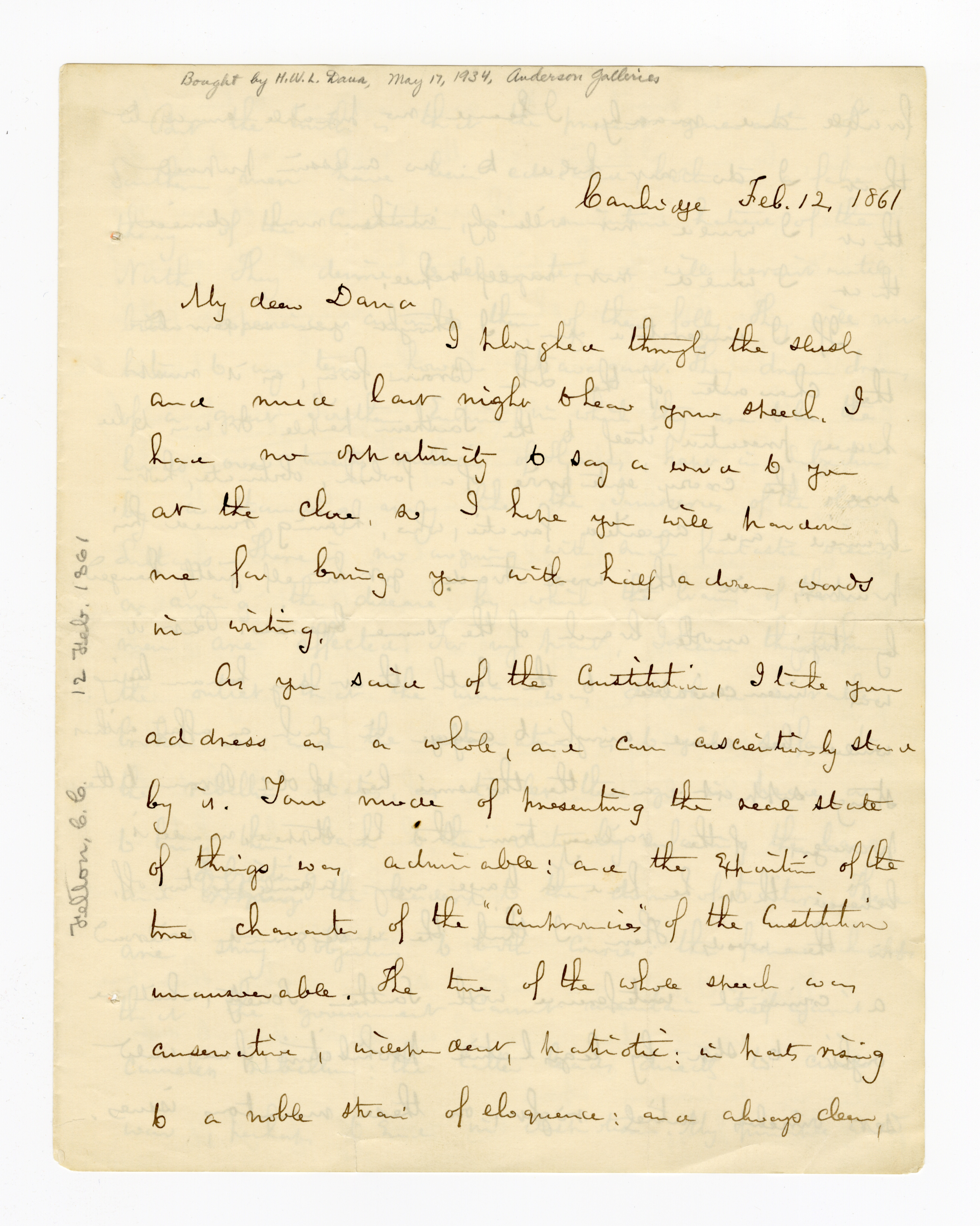
Cornelius Conway Felton to Richard Henry Dana Jr., 12 February 1861
Manuscript letter
[pencil annotation, Henry Wadsworth Longfellow Dana:] “Bought by H.W.L. Dana, May 17, 1934, Anderson Galleries”
[pencil annotation:] “Felton, C. C. 12 Feb. 1861”
Cambridge Feb. 12, 1861
My dear Dana
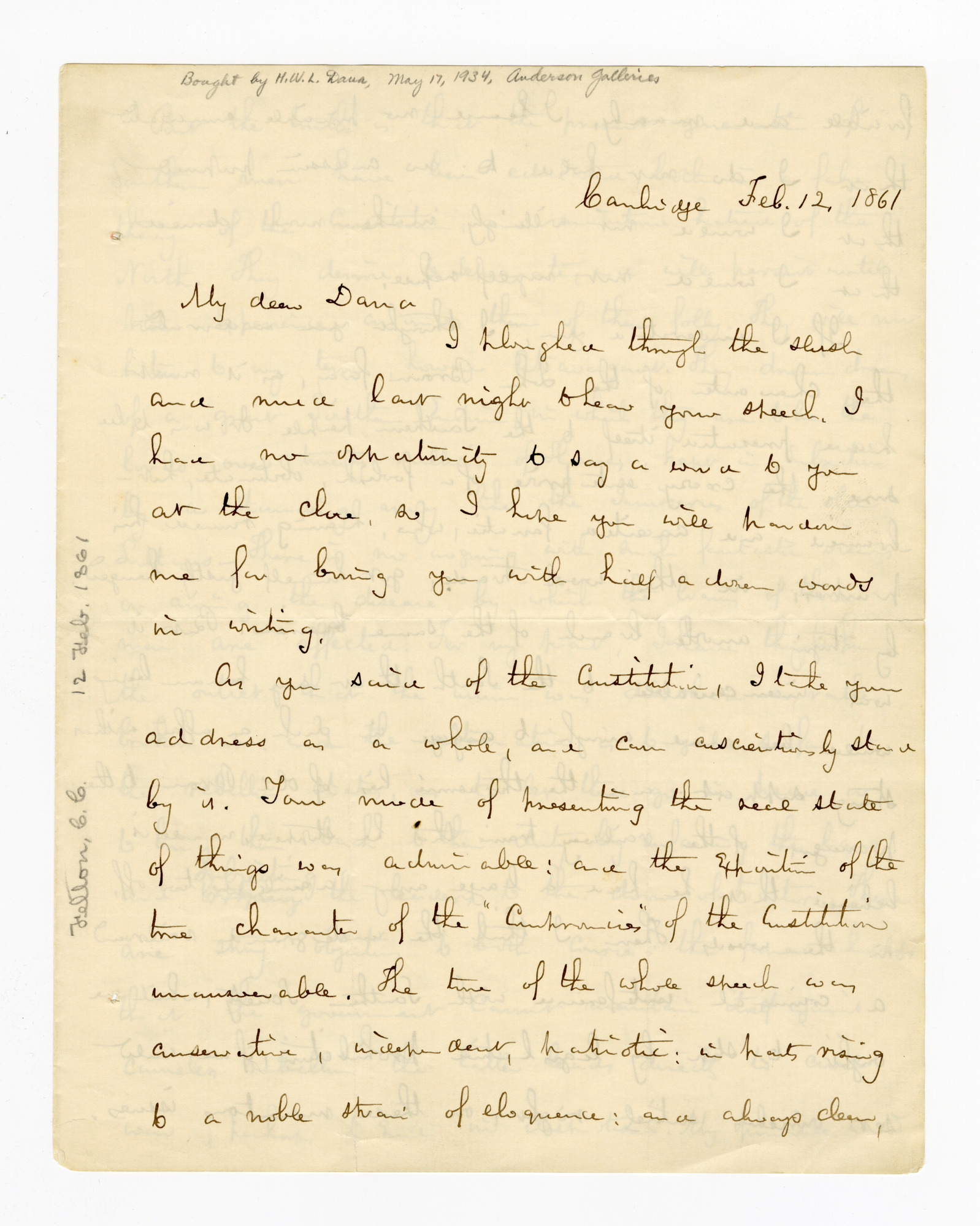
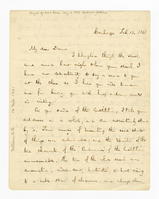
I ploughed through the slush and mud last night to hear your speech. I had no opportunity to say a word to you at the close, so I hope you will pardon me for boring you with half a dozen words in writing.
As you said of the Constitution, I take your address as a whole, and can conscientiously stand by it. Your mode of presenting the real state of things was admirable: and the exposition of the true character of the “Compromises” of the Constitution unanswerable. The tone of the whole speech was conservative, independent, patriotic: in parts rising to a noble strain of eloquence: and always clean, [page 2] forcible and manly. I heard no principle enunciated that I do not hold to: no concession proposed that I would not willingly make: none denied that I would not myself refuse.
If I understood you, I thought you underrated the character of the John Brown foray, as it must have presented itself to the Southern people. It was, to be sure, the crazy enterprise of a foolish, obstinate, [hare]-brained and conceited fanatic, who, having ruined his partners in the wool-trade, got himself justly hanged by trying another branch of the same business. But it was inconceivable to the South that any human being would be mad enough to engage in such an affair without strong support: and the [thra-?] [lies?] of Old Brown to the passengers of the railway train this he stopped, made [to] [believed] that he had a large army a mile or two off, in the woods. Then I think the underground railroad a criminal interference with Southern Society, which [we] ought to stop by legislative prohibition, if we would set ourselves entirely right, on these momentous issues.
[page 3] But the truth is that the present generation of Southern men have been educated, both in a false theory of the Constitution, and an intense hatred of the North. They desire to separate, and will persist until bitter Experience convinces them of their folly. They will not listen to any terms, however Extravagant. They dream dreams of a great Southern Empire, in which they are to be the lords over twenty millions of Slaves, kept in Subjugation by a standing army like the Janissaries of the old Sultans. There is no arguing with such fantastic visions or curing the disease by which the brains of these men are affected. For my part, I have thought from the outset that the union was dissolved—or rather broken up: and the alternative is to yield so far to the rebellion states, as to let them go in peace, or to bring them back to their duty by enforcing the laws and subjecting [word below “subjecting” crossed out] the leaders to the doom of traitors. There are strong objections to both courses: the former acknowledges that the government cannot maintain itself against [c—len?] rebellion: the latter leads directly to civil war, perhaps to end in destruction. My principle would [page 4] incline me to maintain the government, and to hang the traitors, because I believe in the right and duty of lawful government, and that its powers should not be frittered away, by holding any terms with the agents of treason. The President should have manned and [f-?] the strong-holds a year ago: he should have appealed to the country, the moment the secession ordinance was passed by Carolina, and called things by their right names [written above: “in an energetic proclamation”]: he should have refused to receive any communication from the Commissioners: he should have arrested the traitors in his Cabinet, and put them upon their trial as soon as possible: and if the country failed to sustain him, then the fault would not have been his. But the country would have sustained him. Half a million of men in arms would have been at his beck before this, if needed. I think Fremont would have not the crisis so, had we been fortunate enough to elect him. The question whether we have a government or not would have been long since settled.
Well, I did not intend to cover a whole sheet: but it is a rainy day, and I wanted somebody to bestow my tediousness upon.
Every truly yours C. C. Felton
R. H. Dana Jr. Esq.
[pencil annotation:] “Felton, C. C. 12 Feb. 1861”
Cambridge Feb. 12, 1861
My dear Dana
I ploughed through the slush and mud last night to hear your speech. I had no opportunity to say a word to you at the close, so I hope you will pardon me for boring you with half a dozen words in writing.
As you said of the Constitution, I take your address as a whole, and can conscientiously stand by it. Your mode of presenting the real state of things was admirable: and the exposition of the true character of the “Compromises” of the Constitution unanswerable. The tone of the whole speech was conservative, independent, patriotic: in parts rising to a noble strain of eloquence: and always clean, [page 2] forcible and manly. I heard no principle enunciated that I do not hold to: no concession proposed that I would not willingly make: none denied that I would not myself refuse.
If I understood you, I thought you underrated the character of the John Brown foray, as it must have presented itself to the Southern people. It was, to be sure, the crazy enterprise of a foolish, obstinate, [hare]-brained and conceited fanatic, who, having ruined his partners in the wool-trade, got himself justly hanged by trying another branch of the same business. But it was inconceivable to the South that any human being would be mad enough to engage in such an affair without strong support: and the [thra-?] [lies?] of Old Brown to the passengers of the railway train this he stopped, made [to] [believed] that he had a large army a mile or two off, in the woods. Then I think the underground railroad a criminal interference with Southern Society, which [we] ought to stop by legislative prohibition, if we would set ourselves entirely right, on these momentous issues.
[page 3] But the truth is that the present generation of Southern men have been educated, both in a false theory of the Constitution, and an intense hatred of the North. They desire to separate, and will persist until bitter Experience convinces them of their folly. They will not listen to any terms, however Extravagant. They dream dreams of a great Southern Empire, in which they are to be the lords over twenty millions of Slaves, kept in Subjugation by a standing army like the Janissaries of the old Sultans. There is no arguing with such fantastic visions or curing the disease by which the brains of these men are affected. For my part, I have thought from the outset that the union was dissolved—or rather broken up: and the alternative is to yield so far to the rebellion states, as to let them go in peace, or to bring them back to their duty by enforcing the laws and subjecting [word below “subjecting” crossed out] the leaders to the doom of traitors. There are strong objections to both courses: the former acknowledges that the government cannot maintain itself against [c—len?] rebellion: the latter leads directly to civil war, perhaps to end in destruction. My principle would [page 4] incline me to maintain the government, and to hang the traitors, because I believe in the right and duty of lawful government, and that its powers should not be frittered away, by holding any terms with the agents of treason. The President should have manned and [f-?] the strong-holds a year ago: he should have appealed to the country, the moment the secession ordinance was passed by Carolina, and called things by their right names [written above: “in an energetic proclamation”]: he should have refused to receive any communication from the Commissioners: he should have arrested the traitors in his Cabinet, and put them upon their trial as soon as possible: and if the country failed to sustain him, then the fault would not have been his. But the country would have sustained him. Half a million of men in arms would have been at his beck before this, if needed. I think Fremont would have not the crisis so, had we been fortunate enough to elect him. The question whether we have a government or not would have been long since settled.
Well, I did not intend to cover a whole sheet: but it is a rainy day, and I wanted somebody to bestow my tediousness upon.
Every truly yours C. C. Felton
R. H. Dana Jr. Esq.
Archives Number: 1002/9.3-054#004
U. S. National Park Service
Permission must be secured from the individual copyright owners to reproduce any copyrighted materials contained within this website.
Courtesy of National Park Service, Longfellow House-Washington's Headquarters National Historic Site; Archives Number 1002/9.3-054#004
Public domain
Collected Materials (1002/009), (LONG-SeriesName)
, Miscellaneous Famous People (1002/009.003), (LONG-SubseriesName)
, Felton, Cornelius Conway (1807-1862) Papers, 1843-1861 (1002/009.003-054), (LONG-FileUnitName)
, Miscellaneous Famous People (1002/009.003), (LONG-SubseriesName)
, Felton, Cornelius Conway (1807-1862) Papers, 1843-1861 (1002/009.003-054), (LONG-FileUnitName)
Image
Longfellow House - Washington's Headquarters National Historic Site, Code: LONG
Longfellow House - Washington's Headquarters National Historic Site, Middlesex County, Massachusetts
Latitude: 42.3769989013672, Longitude: -71.1264038085938
Latitude: 42.3769989013672, Longitude: -71.1264038085938
Title: Finding Aid to the Henry Wadsworth Longfellow Dana (1881-1950) Papers, 1744-1972 (bulk dated: 1850-1950)
URL: https://www.nps.gov/long/learn/historyculture/archives.htm#HWLD
URL: https://www.nps.gov/long/learn/historyculture/archives.htm#HWLD
2023/06/28
02/12/1861
Manuscript letter in Henry Wadsworth Longfellow Dana Papers, Series IX. Collected Materials, C. Miscellaneous Famous People. (1002/9.3-054#004)
Public Can View
Organization: Longfellow House-Washington's Headquarters National Historic Site
Address: 105 Brattle Street, Cambridge, MA 02138
Email: LONG_archives@nps.gov
Address: 105 Brattle Street, Cambridge, MA 02138
Email: LONG_archives@nps.gov
Wednesday, February 21, 2024 12:21:22 AM
Wednesday, February 21, 2024 12:21:22 AM
1002-9-3-054 09.jpg
jpg
2.5 MB
Historic