Select Item below to DOWNLOAD - Once item is selected, right click and choose 'save as'



787927f8-a89f-45a0-b1ab-fed39858633b
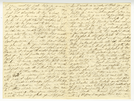
Frances (Appleton) Longfellow to Mary (Appleton) Mackintosh, 30 November 1846
Manuscript letter
Cambridge. Nov 30th 1846.
Dearest Mary,
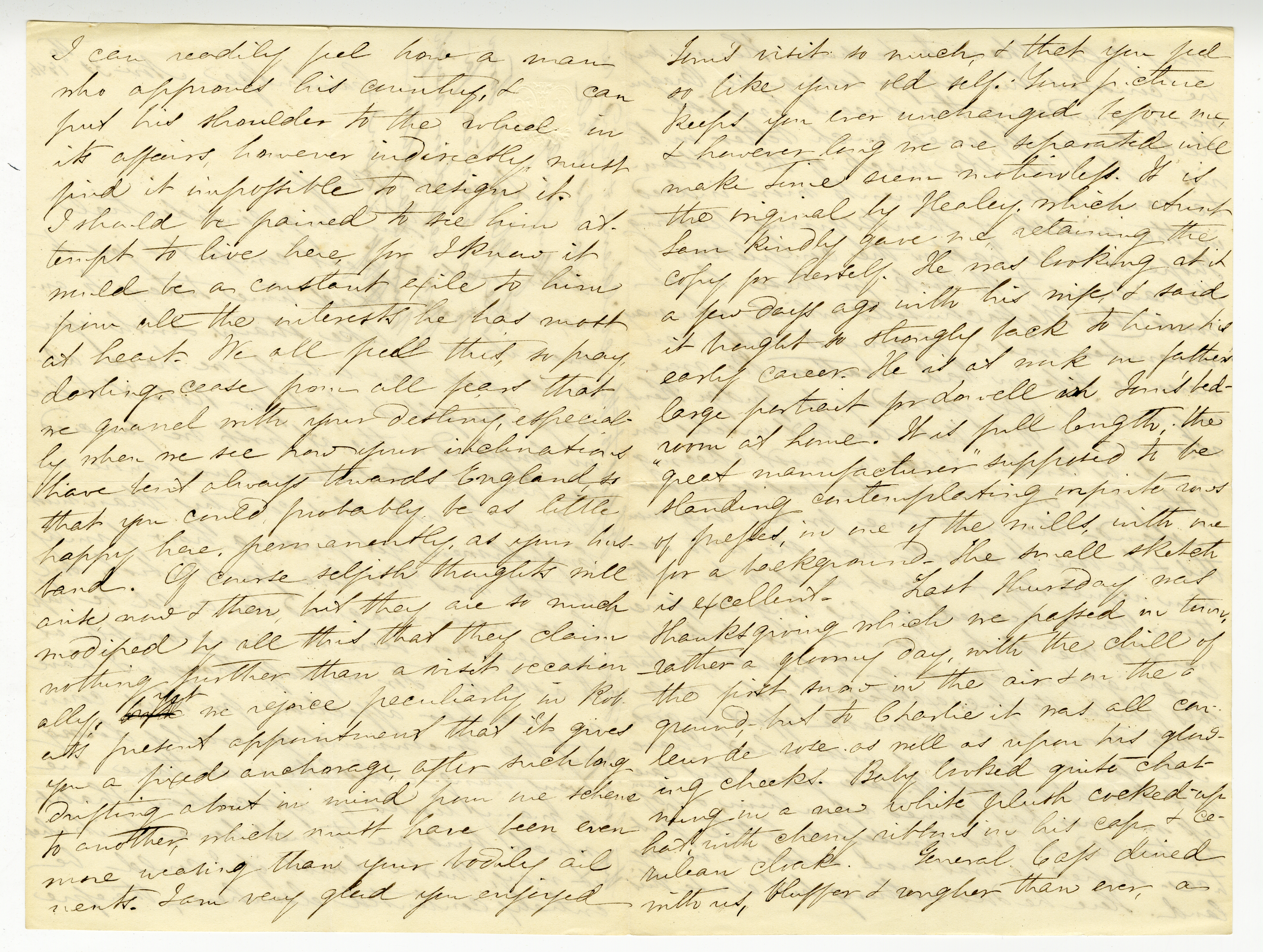
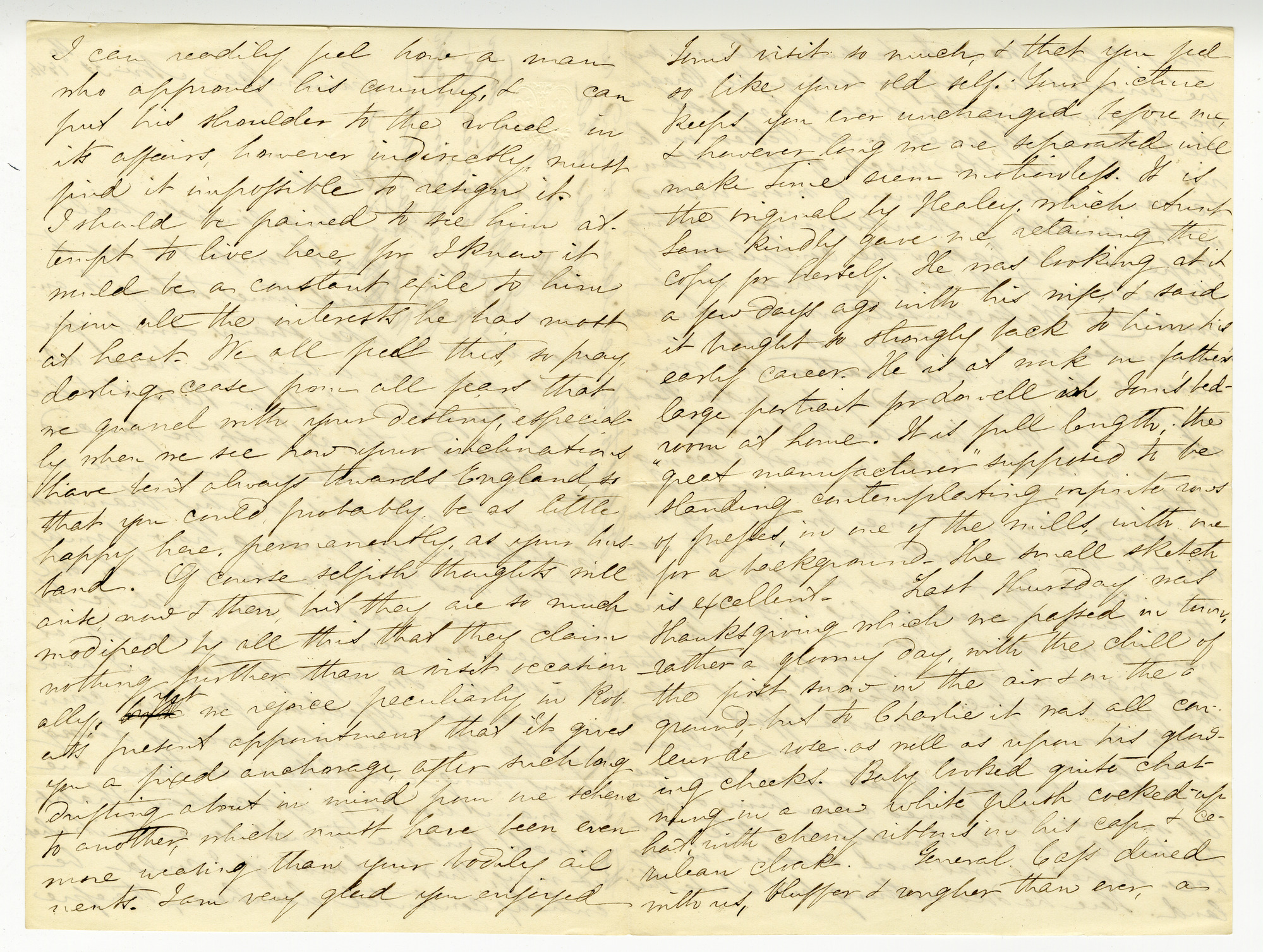
Your long, confidential letter was a great comfort & joy to me, & I wish I had time today to answer it in a like strain. I wish you could feel how entirely we have always thought it best for Robert to live in England, & tho’, at first, we fancied he had few ties there, & was more inclined to like this country than most Englishmen, yet finding how firmly rooted was his love for British soil, have never imagined he could be happy here, nor been so unreasonable as to ask it. For myself, though I have no peculiar affection for this country, the Government generally doing everything I dislike, yet there are so many links of association & habit which bind one to one’s home, be it where it may, that I doubt if I could be entirely contented elsewhere, therefore [p. 2] I can readily feel how a man who approves his country & can put his shoulder to the wheel in its affairs, however indirectly, must find it impossible to resign it. I should be pained to see him attempt to live here, for I know it would be a constant exile to him from all the interests he has most at heart. We all feel this, so Mary, darling, cease from all fears that we quarrel with your destiny, especially when we see how your inclinations have bent always towards England, so that you could probably be as little happy here, permanently, as your husband. Of course selfish thoughts will arise, now & then, but they are so much modified by all this that they claim nothing further than a visit occasionally, yet we rejoice peculiarly in Robert’s present appointment that it gives you a fixed anchorage, after such long drifting about in mind from one scheme to another, which must have been even more wearing than your bodily ailments. I am very glad you enjoyed [p. 3] Tom’s visit so much, & that you feel so like your old self. Your picture keeps you ever unchanged before me, & however long we are separated will make Time seem motionless. It is the original by Healey, which Aunt Sam kindly gave me, retaining the copy for herself. He was looking at it a few days ago with his wife, & said it brought so strongly back to him his early career. He is at work on father’s large portrait for Lowell in Tom’s bedroom at home. It is full length, the “great manufacturer” supposed to be standing contemplating infinite rows of presses, in one of the mills, with one for a background. The small sketch is excellent. Last Thursday was Thanksgiving which we passed in town, rather a gloomy day, with the chill of the first snow in the air & on the ground, but to Charlie it was all coleur de rose as well as upon his glowing cheeks. Baby looked quite charming in a new white plush cocked-up hat, with cherry ribbons in his cap & cerulean cloak. General Cass dined with us, bluffer & rougher than ever, a [p. 4] very jolly Mars to be sure. Henry says he consoles himself for losing the Oregon war by murdering the Queen’s English. He certainly appeared much better in Paris. This horrible wreck of the Atlantic came like a memento mori indeed in the midst of Thanksgiving feasting I hope it will hasten the completion of the railway to N. York, for these huge boats (the Massachusetts which you may remember was a pigmy to this) can never be safe in bad weather. We were very anxious yesterday for Judge Kent, who went to N.Y. that day, but wisely continued by land. I had a most cheering letter from Emmeline. She has seen her husband – the first time for six long months, & he bore it so well that she is to see him regularly, & in fact, he is to be with them, being wearied of his long confinement to one spot. I cannot but hope her long night is beginning to brighten, & that this philanthropic exaltation of his will settle down into a reasonable effort for good. All you say of Tom is just what I have felt keenly myself. Of late years this careless manner has gained upon him, & I am often troubled he does himself so little justice. I hoped he was more subdued in England. Here he does nothing but abuse this [p. 5] country & exalt yours, so that I was amused that you found it the reverse, but he has a strange spirit of contradiction in him, which I believe makes him say many things that are not settled convictions, or, perhaps, as he says, his mind has such scope that he sees so much truth on all sides of a question he never does settle upon convictions but finds the good & ill so balanced that he will not pin himself to any fixed belief. I know so well his deep, & tender reverence for holy things that I confess I often marvel, & grieve too, at the laughing Mephistopheles that peeps out now & then. I think the only way is to judge his character by its general tendencies, not by detail, as to feel the beauty of a Cathedral you must seize the whole at a distance & not criticize the grotesque carvings & grinning monsters over your head. So viewed, he is certainly a noble, lofty, & most rich work of God, with a heart which deserves a settled [p. 6] home, & will not I trust be always comforting itself with the waifs of chance friendships only. He wants a north star for his scattered magnetism, & then would be softened into a more consistent character.
Talking of cathedrals, reminds me that Mr Gannett’s church is rather indignant just now because Mr Upjohn, the best church architect we have, refuses to design them a new building, (they being driven out of Federal St by invading warehouses) because “after prayerful consideration” he cannot, conscientiously, plan for a Unitarian congregation. You may conceive what narrow bigotry this seems here. We have several promising young architects, however, so I hope they will get something to worship in, though I shall greatly grieve to see the church rendered so sacred to me by Dr Channing’s presence & many early associations, pulled down by sacrilegious hands. [p. 7] Such a soul as his consecrates a church, no foolish ceremonies or superstitious creeds can do it. If not one brick is left upon another that must be always holy ground to many, for words of life & faith have been uttered there which, if embodied in practise [sic] & politics, would make the world the kingdom of heaven, & not full of Cains alas! & ‘Christian unbelievers.’
I have seen many numbers of late of your “People’s Journal,” which I like greatly, such a believing, hopeful spirit is in it. This greatest faith that God did not utter his truth, through Christ, to be without priest in the world, that he meant nations to be friends & brothers & not wolves or foxes, one may almost say is the blessed birth of this age, as much as this new planet is, &, on this side of the water, are many who rejoice to find such sympathy therein in England. Have you seen a book called Martyria? It has some fine passages [p. 8] in it, tho’ almost too much cumbered by its antique style. I am reading a poem called “the New Simon” which I find rather dull, tho’ I hear it is admired much. I have been much vexed of late with household matters, making the painful discovery of dishonesty in servants &c Oh that there could be some patent, self-oiling machine for domestic work, but I suppose I should be thought to have more than my share of good fortune without these rubs now & then. It is delightful to see Aunt Sam walking about her drawing room again so miraculously. Uncle S. is fresh as a rose, tho’ now 80, & Uncle Isaac was here the other day, very brisk & cheerful, but his moods vary with the seasons. I saw Mrs Sidney Brooks in town, as sunny as ever, tho’ subdued by her sister’s death. Anna Shaw has a girl, & therefore will not probably continue to do her own work. You ask after Mad d’Hautville – she is still lovely, & enjoying her fine boy who must now be 8 or more. I believe her husband that was, has no children by his second marriage, which is a pity. The Prescotts are flourishing, Lizzie P. is one of the come-outers at Aunt Am’s ball.
With much love from Henry ever dearest [p. 1 cross] thy loving Fanny - Kisses to the children & Kind regards to all your family
The Mayor of Toronto has married father’s next door neighbors’ daughter – Miss Dixon
Dearest Mary,
Your long, confidential letter was a great comfort & joy to me, & I wish I had time today to answer it in a like strain. I wish you could feel how entirely we have always thought it best for Robert to live in England, & tho’, at first, we fancied he had few ties there, & was more inclined to like this country than most Englishmen, yet finding how firmly rooted was his love for British soil, have never imagined he could be happy here, nor been so unreasonable as to ask it. For myself, though I have no peculiar affection for this country, the Government generally doing everything I dislike, yet there are so many links of association & habit which bind one to one’s home, be it where it may, that I doubt if I could be entirely contented elsewhere, therefore [p. 2] I can readily feel how a man who approves his country & can put his shoulder to the wheel in its affairs, however indirectly, must find it impossible to resign it. I should be pained to see him attempt to live here, for I know it would be a constant exile to him from all the interests he has most at heart. We all feel this, so Mary, darling, cease from all fears that we quarrel with your destiny, especially when we see how your inclinations have bent always towards England, so that you could probably be as little happy here, permanently, as your husband. Of course selfish thoughts will arise, now & then, but they are so much modified by all this that they claim nothing further than a visit occasionally, yet we rejoice peculiarly in Robert’s present appointment that it gives you a fixed anchorage, after such long drifting about in mind from one scheme to another, which must have been even more wearing than your bodily ailments. I am very glad you enjoyed [p. 3] Tom’s visit so much, & that you feel so like your old self. Your picture keeps you ever unchanged before me, & however long we are separated will make Time seem motionless. It is the original by Healey, which Aunt Sam kindly gave me, retaining the copy for herself. He was looking at it a few days ago with his wife, & said it brought so strongly back to him his early career. He is at work on father’s large portrait for Lowell in Tom’s bedroom at home. It is full length, the “great manufacturer” supposed to be standing contemplating infinite rows of presses, in one of the mills, with one for a background. The small sketch is excellent. Last Thursday was Thanksgiving which we passed in town, rather a gloomy day, with the chill of the first snow in the air & on the ground, but to Charlie it was all coleur de rose as well as upon his glowing cheeks. Baby looked quite charming in a new white plush cocked-up hat, with cherry ribbons in his cap & cerulean cloak. General Cass dined with us, bluffer & rougher than ever, a [p. 4] very jolly Mars to be sure. Henry says he consoles himself for losing the Oregon war by murdering the Queen’s English. He certainly appeared much better in Paris. This horrible wreck of the Atlantic came like a memento mori indeed in the midst of Thanksgiving feasting I hope it will hasten the completion of the railway to N. York, for these huge boats (the Massachusetts which you may remember was a pigmy to this) can never be safe in bad weather. We were very anxious yesterday for Judge Kent, who went to N.Y. that day, but wisely continued by land. I had a most cheering letter from Emmeline. She has seen her husband – the first time for six long months, & he bore it so well that she is to see him regularly, & in fact, he is to be with them, being wearied of his long confinement to one spot. I cannot but hope her long night is beginning to brighten, & that this philanthropic exaltation of his will settle down into a reasonable effort for good. All you say of Tom is just what I have felt keenly myself. Of late years this careless manner has gained upon him, & I am often troubled he does himself so little justice. I hoped he was more subdued in England. Here he does nothing but abuse this [p. 5] country & exalt yours, so that I was amused that you found it the reverse, but he has a strange spirit of contradiction in him, which I believe makes him say many things that are not settled convictions, or, perhaps, as he says, his mind has such scope that he sees so much truth on all sides of a question he never does settle upon convictions but finds the good & ill so balanced that he will not pin himself to any fixed belief. I know so well his deep, & tender reverence for holy things that I confess I often marvel, & grieve too, at the laughing Mephistopheles that peeps out now & then. I think the only way is to judge his character by its general tendencies, not by detail, as to feel the beauty of a Cathedral you must seize the whole at a distance & not criticize the grotesque carvings & grinning monsters over your head. So viewed, he is certainly a noble, lofty, & most rich work of God, with a heart which deserves a settled [p. 6] home, & will not I trust be always comforting itself with the waifs of chance friendships only. He wants a north star for his scattered magnetism, & then would be softened into a more consistent character.
Talking of cathedrals, reminds me that Mr Gannett’s church is rather indignant just now because Mr Upjohn, the best church architect we have, refuses to design them a new building, (they being driven out of Federal St by invading warehouses) because “after prayerful consideration” he cannot, conscientiously, plan for a Unitarian congregation. You may conceive what narrow bigotry this seems here. We have several promising young architects, however, so I hope they will get something to worship in, though I shall greatly grieve to see the church rendered so sacred to me by Dr Channing’s presence & many early associations, pulled down by sacrilegious hands. [p. 7] Such a soul as his consecrates a church, no foolish ceremonies or superstitious creeds can do it. If not one brick is left upon another that must be always holy ground to many, for words of life & faith have been uttered there which, if embodied in practise [sic] & politics, would make the world the kingdom of heaven, & not full of Cains alas! & ‘Christian unbelievers.’
I have seen many numbers of late of your “People’s Journal,” which I like greatly, such a believing, hopeful spirit is in it. This greatest faith that God did not utter his truth, through Christ, to be without priest in the world, that he meant nations to be friends & brothers & not wolves or foxes, one may almost say is the blessed birth of this age, as much as this new planet is, &, on this side of the water, are many who rejoice to find such sympathy therein in England. Have you seen a book called Martyria? It has some fine passages [p. 8] in it, tho’ almost too much cumbered by its antique style. I am reading a poem called “the New Simon” which I find rather dull, tho’ I hear it is admired much. I have been much vexed of late with household matters, making the painful discovery of dishonesty in servants &c Oh that there could be some patent, self-oiling machine for domestic work, but I suppose I should be thought to have more than my share of good fortune without these rubs now & then. It is delightful to see Aunt Sam walking about her drawing room again so miraculously. Uncle S. is fresh as a rose, tho’ now 80, & Uncle Isaac was here the other day, very brisk & cheerful, but his moods vary with the seasons. I saw Mrs Sidney Brooks in town, as sunny as ever, tho’ subdued by her sister’s death. Anna Shaw has a girl, & therefore will not probably continue to do her own work. You ask after Mad d’Hautville – she is still lovely, & enjoying her fine boy who must now be 8 or more. I believe her husband that was, has no children by his second marriage, which is a pity. The Prescotts are flourishing, Lizzie P. is one of the come-outers at Aunt Am’s ball.
With much love from Henry ever dearest [p. 1 cross] thy loving Fanny - Kisses to the children & Kind regards to all your family
The Mayor of Toronto has married father’s next door neighbors’ daughter – Miss Dixon
Archives Number: 1011/002.001-016#015
U. S. National Park Service
Permission must be secured from the individual copyright owners to reproduce any copyrighted materials contained within this website.
Courtesy of National Park Service, Longfellow House-Washington's Headquarters of National Historic Site
Public domain
Correspondence (1011/002), (LONG-SeriesName)
, Letters from Frances Longfellow (1011/002.001), (LONG-SubseriesName)
, 1846 (1011/002.001-016), (LONG-FileUnitName)
, Letters from Frances Longfellow (1011/002.001), (LONG-SubseriesName)
, 1846 (1011/002.001-016), (LONG-FileUnitName)
Image
Longfellow House - Washington's Headquarters National Historic Site, Code: LONG
Longfellow House - Washington's Headquarters National Historic Site, Middlesex County, Massachusetts
Latitude: 42.3769989013672, Longitude: -71.1264038085938
Latitude: 42.3769989013672, Longitude: -71.1264038085938
NPS Museum Number Catalog : LONG 20257
Title: Finding Aid to the Frances Elizabeth Appleton Longfellow (1817-1861) Papers, 1825-1961 (bulk dated: 1832-1861)
URL: https://www.nps.gov/long/learn/historyculture/archives.htm#FEAL
URL: https://www.nps.gov/long/learn/historyculture/archives.htm#FEAL
2016-08-08
11/30/1846
Manuscript letter in Frances Appleton Longfellow Papers, Series II. Correspondence, A. Outgoing, 1846. (1011/002.001-016#015)
Public Can View
Organization: Longfellow House-Washington's Headquarters National Historic Site
Address: 105 Brattle Street, Cambridge, MA 02138
Email: LONG_archives@nps.gov
Address: 105 Brattle Street, Cambridge, MA 02138
Email: LONG_archives@nps.gov
Wednesday, November 9, 2022 6:20:51 PM
Wednesday, November 9, 2022 6:20:51 PM
1011-02-01-16-15 p2+3.jpg
jpg
18.4 MB
Historic