Select Item below to DOWNLOAD - Once item is selected, right click and choose 'save as'


3b3cf73d-52e9-4702-96cb-e12111b4aa66
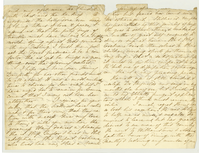
Frances (Appleton) Longfellow to Emmeline (Austin) Wadsworth, 21 August 1846
Manuscript letter
It was very good & kind of you, dearest Em, to write me, & I thank you from my heart for your loving words of sympathy. I cannot say I have been alarmed about the children, but very anxious, for here many have died of this complaint, & in Boston & everywhere mortality has been unusually great the summer has been such a changeable season. They are now, I rejoice to say, quite well again, but poor, little Charlie is reduced to a skeleton & can hardly walk for weakness but having, within a day or two, the voracious appetite of convalescence I trust he will soon regain what he has lost. He was so well & happy at Portland, that I felt quite remorseful for having brought him here, & my visit has been such a dreary one that the charm of this region is quite dimmed in my eyes. I had the entire care of the baby [p. 2] which prevented my writing you sooner, & when the care & anxiety passed by, I became quite ill myself, so that I have been entirely confined to the house. Yesterday was so cold & gloomy that we could not go to Stockbridge, which we have not yet seen, & today it is pouring, so that I doubt if we shall accomplish it at all, for we leave on Monday morning, &, passing the night at Worcester, shall reach home to dinner. I dread the journey not a little, we had such an intolerable day of it coming up, but as to remaining here after Henry leaves I have no heart for it, & really believe the children would be as well off at home. it is not Commencement only which obliges him to return, but his duties recommence in a few days, & he could not desert his post. It seems my fatality to have illness under Harriet’s roof, & she lacks the ready sympathy & thoughtful kindness which consoles one for being out of one’s own house. I have had, entre [p. 3] nous, some pretty sad days, for this old mansion is associated with such unfailing devotion & affection that the changes in it have given me so much more pain than pleasure I feel as if I could never come here again. Aunt Dorothy had her house filled or I should have gone there. She has been all kindness, sending Charlie daily rice gruel &c. He has had all his meals at her hands. the Sedgwicks all came down to see me with Mrs Rogers, the widow, who is staying at Lenox, & I truly hope I shall see them again. The Wards kindly invited us to a tea party (she receives weekly) but we could not go. Henry went afterwards to see them with Father, & quite envied them their quiet, rural life Her children were all very ill lately with scarlet fever, & she was reduced, as I have been, to the common practice for lack of homoepathic [sic] physicians. Imagine my horror when the doctor here proposed laudanum to be given to my babies every [p. 4] hour & calomel besides. We persuaded him out of the last fortunately. The Lowells also come to see us, & her pale, thin face & hollow cough were sad omens of her fate. She has enjoyed the country here (they have been at a farmhouse between Lenox & Stockbridge) but she has gained nothing from the mountain air, and her last hope fails her. It must be hard for her to turn her thoughts to another world leaving such treasures in this – a sweet child, a girl too, & a most loving husband. Poor Lowell, his harp, which has saddened only for others sorrows, will have a string of deeper tone added to its quick sensibilities. I cannot help thinking, when I see her, of his prayer beginning: “God! do not let my loved one die.”
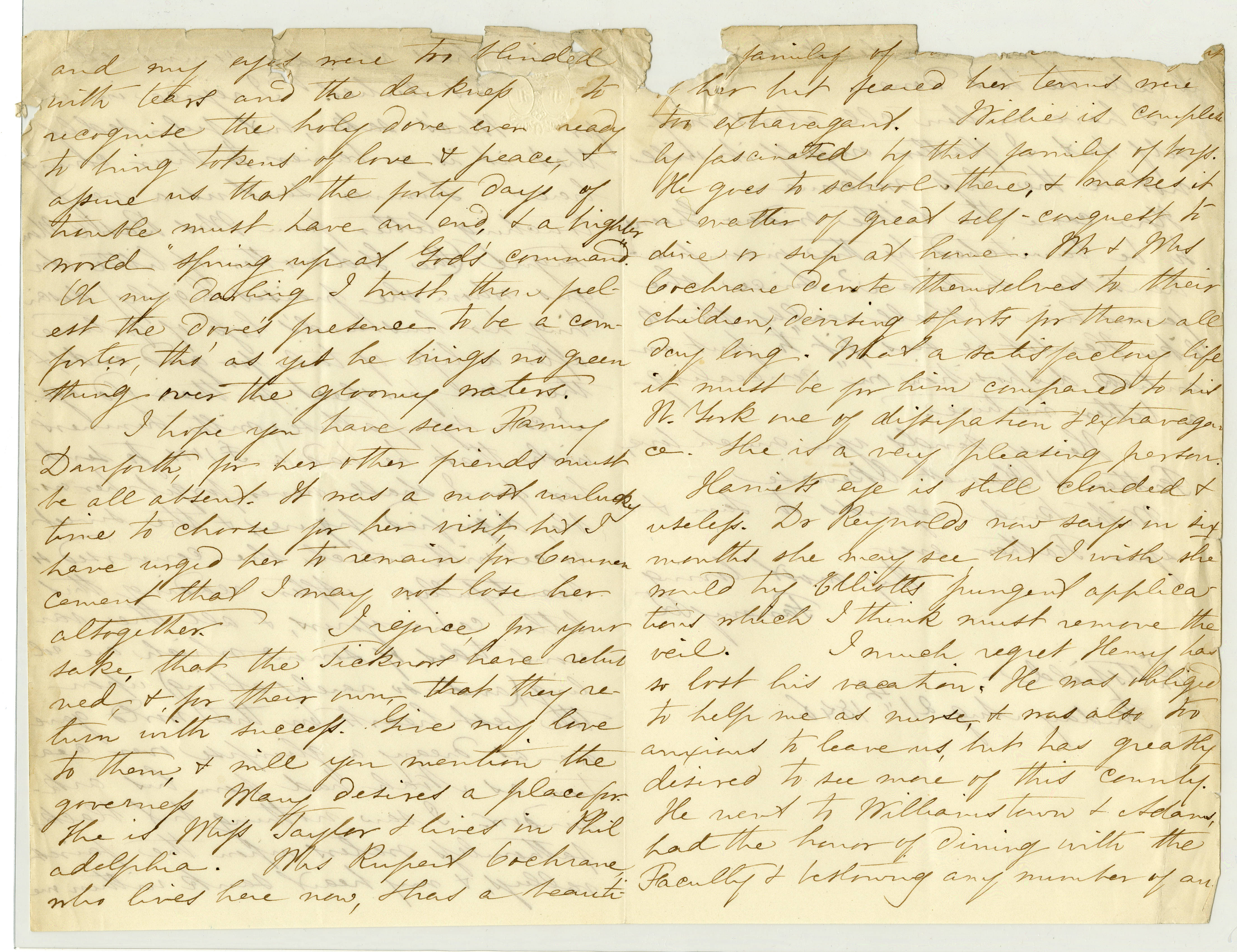
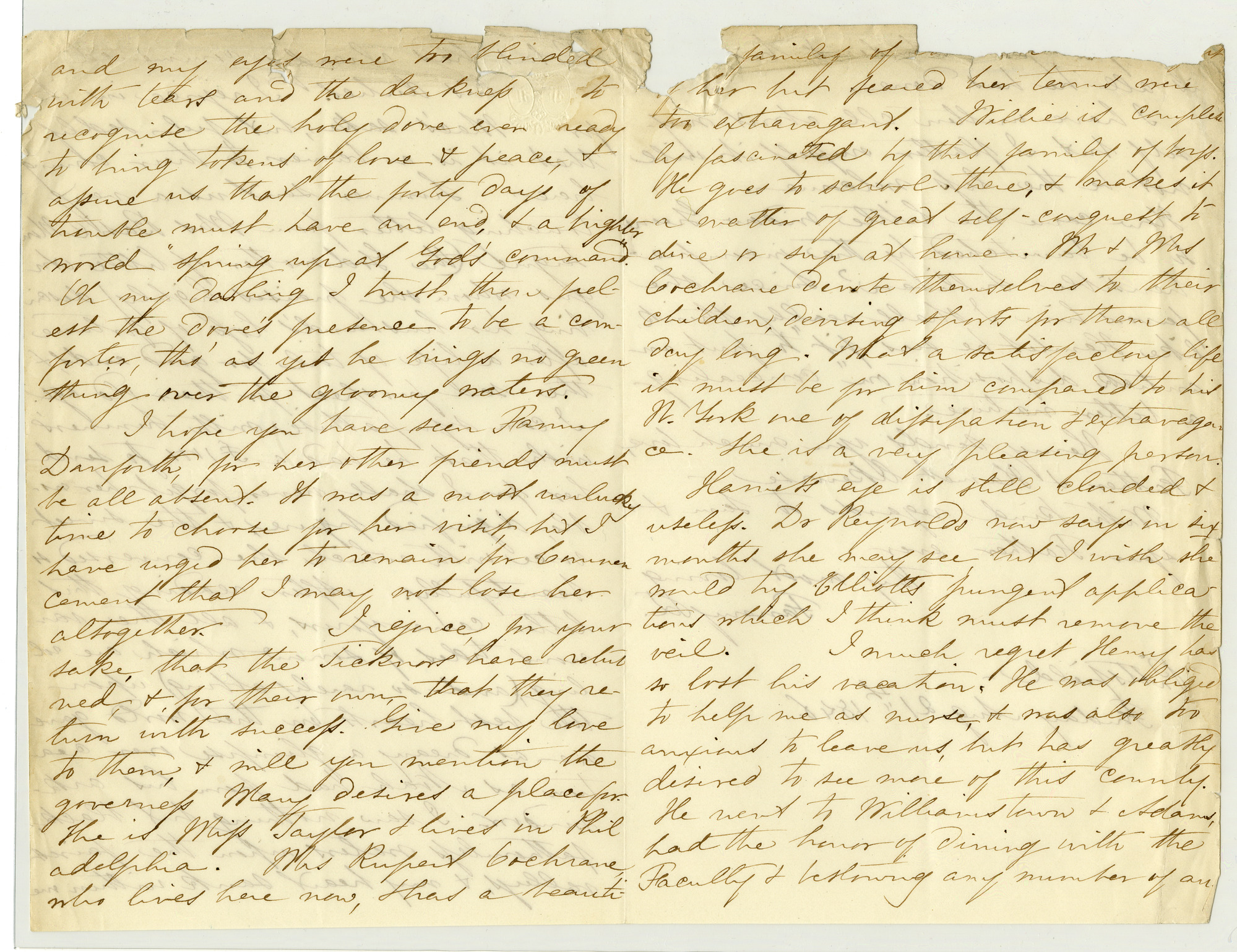
Did Father remember to tell you of Mackintosh’s appointment as private secretary to Lord Mopeth under the new administration They are much pleased with it, as it is an agreeable office, & very flattering, coming, unsolicited, from so excellent a person. They will move to London in October where [p. 5] Robert has already commencd [sic] his duties. I rejoice in it for Mac’s sake, but feel sadly that it is a barrier to their coming here. Sumner sent us a very touching letter from Mrs Basil Montagne (the Godmother of little Angus whom she praises highly) describing her husband’s loss of fortune after a loss of toil for good ends, & the sad prospect for their old age. I can sympathise with Sumner’s wish that he had a £1000 to send her for I shall never forget her noble, dignified figure, & the sweet voice with which she conversed so beautifully. After reading this letter came yours, & all the various tides of sorrow which are rolling, (and so rarely ebbing) upon the best hearts in the world gave me as dreary a glimpse over creation as Noah had from his ark-window. I saw nothing but black, fathomless waters upon the fairest valleys, & my heart sank within me [p. 6] and my eyes were too blinded with tears and the darkness to recognise the holy dove ever ready to bring tokens of love & peace, & assure us that the forty days of trouble must have an end, & a brighter world “spring up at God’s command.” Oh my darling I trust thou feelest the dove’s presence to be a comforter, tho’ as yet he brings no green thing over the gloomy waters.
I hope you have seen Fanny Danforth, for her other friends must be all absent. It was a most unlucky time to choose for her visit, but I have urged her to remain for Commencement that I may not lose her altogether. I rejoice, for your sake, that the Ticknors have returned, &, for their own, that they return with success. Give my love to them, & will you mention the governess Mary desires a place for. She is Miss Taylor & lives in Philadelphia. Mrs Rupert Cochrane, who lives here now, & has a beauty- [p. 7] [ful] family of [top edge torn off] [of] her but feared her terms were too extravagant. Willie is completely fascinated by this family of boys. He goes to school there, & makes it a matter of great self-conquest to dine or sup at home. Mr & Mrs Cochrane devote themselves to their children, devising sports for them all day long. What a satisfactory life it must be for him compared to his N. York one of dissipation & extravagance. She is a very pleasing person.
Harriet’s eye is still clouded & useless. Dr Reynolds now says in six months she may see, but I wish she would try Elliotts pungent applications which I think must remove the veil. I much regret Henry has so lost his vacation. He was obliged to help me as nurse, & was also too anxious to leave us, but has greatly desired to see more of this country. He went to Williamstown & Adams, had the honor of dining with the Faculty & bestowing any number of an [p. 8] [top edge torn, words lost] [s]tudents, but is all he has done.
I have written all about myself but I flatter myself it will not be less welcome.
How came the little widow Greene to be bewitched by the incomprehensible Sullivan? Since she favors him I shall really think like Hamlet he sees fit “to put an antick disposition on” concealing a betture nature.
Henry sends you much love, Father & Harriet likewise –
With kind regards to Sam & your Father ever
Thy most loving
Fanny L.
Pittsfield –
Friday Aug 21st 1846.
Did Father remember to tell you of Mackintosh’s appointment as private secretary to Lord Mopeth under the new administration They are much pleased with it, as it is an agreeable office, & very flattering, coming, unsolicited, from so excellent a person. They will move to London in October where [p. 5] Robert has already commencd [sic] his duties. I rejoice in it for Mac’s sake, but feel sadly that it is a barrier to their coming here. Sumner sent us a very touching letter from Mrs Basil Montagne (the Godmother of little Angus whom she praises highly) describing her husband’s loss of fortune after a loss of toil for good ends, & the sad prospect for their old age. I can sympathise with Sumner’s wish that he had a £1000 to send her for I shall never forget her noble, dignified figure, & the sweet voice with which she conversed so beautifully. After reading this letter came yours, & all the various tides of sorrow which are rolling, (and so rarely ebbing) upon the best hearts in the world gave me as dreary a glimpse over creation as Noah had from his ark-window. I saw nothing but black, fathomless waters upon the fairest valleys, & my heart sank within me [p. 6] and my eyes were too blinded with tears and the darkness to recognise the holy dove ever ready to bring tokens of love & peace, & assure us that the forty days of trouble must have an end, & a brighter world “spring up at God’s command.” Oh my darling I trust thou feelest the dove’s presence to be a comforter, tho’ as yet he brings no green thing over the gloomy waters.
I hope you have seen Fanny Danforth, for her other friends must be all absent. It was a most unlucky time to choose for her visit, but I have urged her to remain for Commencement that I may not lose her altogether. I rejoice, for your sake, that the Ticknors have returned, &, for their own, that they return with success. Give my love to them, & will you mention the governess Mary desires a place for. She is Miss Taylor & lives in Philadelphia. Mrs Rupert Cochrane, who lives here now, & has a beauty- [p. 7] [ful] family of [top edge torn off] [of] her but feared her terms were too extravagant. Willie is completely fascinated by this family of boys. He goes to school there, & makes it a matter of great self-conquest to dine or sup at home. Mr & Mrs Cochrane devote themselves to their children, devising sports for them all day long. What a satisfactory life it must be for him compared to his N. York one of dissipation & extravagance. She is a very pleasing person.
Harriet’s eye is still clouded & useless. Dr Reynolds now says in six months she may see, but I wish she would try Elliotts pungent applications which I think must remove the veil. I much regret Henry has so lost his vacation. He was obliged to help me as nurse, & was also too anxious to leave us, but has greatly desired to see more of this country. He went to Williamstown & Adams, had the honor of dining with the Faculty & bestowing any number of an [p. 8] [top edge torn, words lost] [s]tudents, but is all he has done.
I have written all about myself but I flatter myself it will not be less welcome.
How came the little widow Greene to be bewitched by the incomprehensible Sullivan? Since she favors him I shall really think like Hamlet he sees fit “to put an antick disposition on” concealing a betture nature.
Henry sends you much love, Father & Harriet likewise –
With kind regards to Sam & your Father ever
Thy most loving
Fanny L.
Pittsfield –
Friday Aug 21st 1846.
Archives Number: 1011/002.001-016#011
U. S. National Park Service
Permission must be secured from the individual copyright owners to reproduce any copyrighted materials contained within this website.
Courtesy of National Park Service, Longfellow House-Washington's Headquarters of National Historic Site
Public domain
Correspondence (1011/002), (LONG-SeriesName)
, Letters from Frances Longfellow (1011/002.001), (LONG-SubseriesName)
, 1846 (1011/002.001-016), (LONG-FileUnitName)
, Letters from Frances Longfellow (1011/002.001), (LONG-SubseriesName)
, 1846 (1011/002.001-016), (LONG-FileUnitName)
Image
Longfellow House - Washington's Headquarters National Historic Site, Code: LONG
Longfellow House - Washington's Headquarters National Historic Site, Middlesex County, Massachusetts
Latitude: 42.3769989013672, Longitude: -71.1264038085938
Latitude: 42.3769989013672, Longitude: -71.1264038085938
NPS Museum Number Catalog : LONG 20257
Title: Finding Aid to the Frances Elizabeth Appleton Longfellow (1817-1861) Papers, 1825-1961 (bulk dated: 1832-1861)
URL: https://www.nps.gov/long/learn/historyculture/archives.htm#FEAL
URL: https://www.nps.gov/long/learn/historyculture/archives.htm#FEAL
2016-08-08
08/21/1846
Manuscript letter in Frances Appleton Longfellow Papers, Series II. Correspondence, A. Outgoing, 1846. (1011/002.001-016#011)
Public Can View
Organization: Longfellow House-Washington's Headquarters National Historic Site
Address: 105 Brattle Street, Cambridge, MA 02138
Email: LONG_archives@nps.gov
Address: 105 Brattle Street, Cambridge, MA 02138
Email: LONG_archives@nps.gov
Wednesday, November 9, 2022 6:22:06 PM
Wednesday, November 9, 2022 6:22:06 PM
1011-02-01-16-11 p6+7.jpg
jpg
18.2 MB
Historic