Select Item below to DOWNLOAD - Once item is selected, right click and choose 'save as'


577a22b4-fdfc-4515-81a5-38befeb28de2
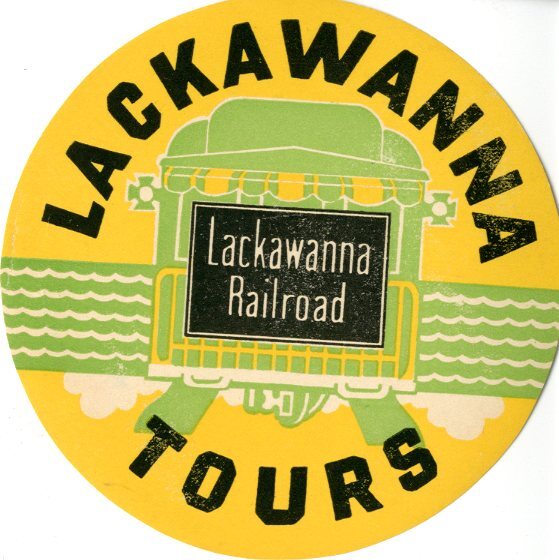
Sticker. "Lackawanna/Tours"
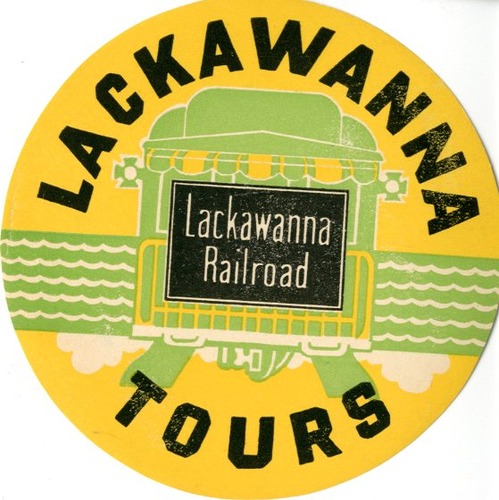
Sticker. "Lackawanna/Tours" in black print around border of yellow disc. In center is a green drawing of an observation car deck. "Lackawanna/Railroad" in white letters within a black box is in the center of the disc. In the background is a heavy band of green and white waves.
From the Museum Collection: Sticker. "Lackawanna/Tours" in black print around border of yellow disc. In center is a green drawing of an observation car deck. "Lackawanna/Railroad" in white letters within a black box is in the center of the disc. In the background is a heavy band of green and white waves. Adhesive backing. Unused. 1910-1930
The Delaware, Lackawanna, and Western Railroad (better known as the Lackawanna and not to be confused with current short line, Delaware-Lackawanna) was one of the Northeast's many anthracite carriers with a history dating back to the early 19th century. Even during the company's peak, it never reached 1,000 miles in size but was nevertheless a well-managed company throughout its corporate history. The company's success during the early 20th century was thanks largely to anthracite coal. It moved millions of tons of anthracite, and before the passage of the Hepburn Act of 1906, owned several mines. Since the Lackawanna was not a large railroad it also did not have an expansive passenger fleet. The DL&W designed and purchased five 4-8-4s (road numbers 1501 through 1505) to increase its motive power for the "Lackawanna Limited" and other passenger trains. These locomotives were assigned Class Q-1 and were built by the American Locomotive Company in 1927. The DL&W decided to call them "Poconos," for the mountains that the railroad crossed. Designed with passenger service in mind, these locomotives had 73" drivers and a tractive effort of 64,500 pounds.
Permission must be secured from the individual copyright owners to reproduce any copyrighted materials contained within this website. Digital assets without any copyright restrictions are public domain.
Steamtown NHS Museum Collection
Public domain:Full Granting Rights
Image
Steamtown National Historic Site, Code: STEA
Steamtown National Historic Site, Lackawanna County, Pennsylvania
Latitude: 41.407600402832, Longitude: -75.6704025268555
Latitude: 41.407600402832, Longitude: -75.6704025268555
1910-1930
01/01/0001
Public Can View
Friday, October 15, 2021 1:15:46 PM
Friday, October 15, 2021 1:42:41 PM
Lackawanna Tours.jpg
Monday, January 1, 0001 12:00:00 AM
jpg
67.6 kB
Scenic