Select Item below to DOWNLOAD - Once item is selected, right click and choose 'save as'

a859d5a6-c674-4f03-8e03-2ba685384987
Menu. "Baltimore and Ohio Railroad/Dining Car Department"
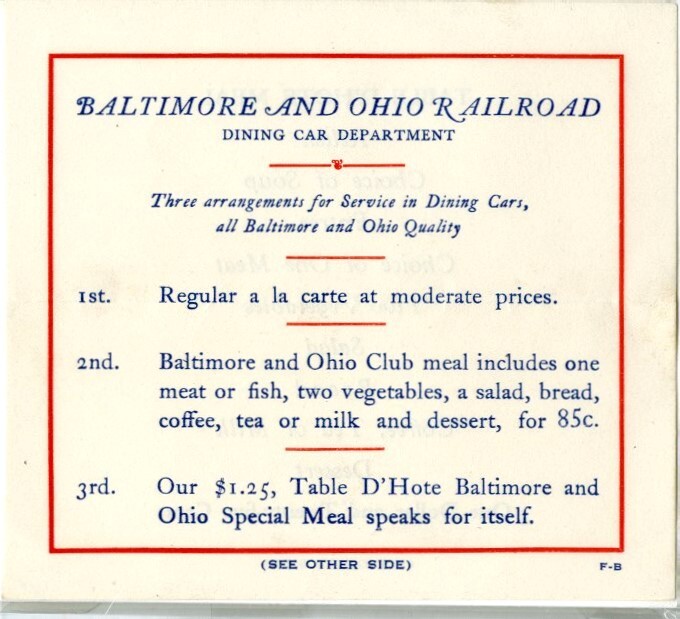
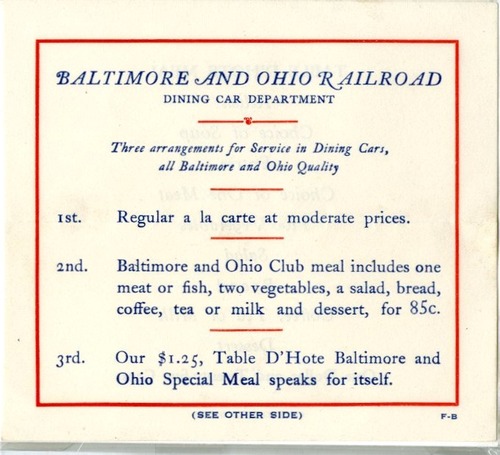
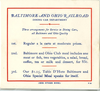
Menu. 1925-1940. "Baltimore and Ohio Railroad/Dining Car Department" at top. Beneath is a summary of three meal arrangements; "(see other side) f-b" on lower edge. Reverse lists courses of "Table D'hote Meal" and price "one dollar and twenty-five cents." Red & blue print on white stock. Fold in center.
From the Museum Collection: Menu. 1925-1940. "Baltimore and Ohio Railroad/Dining Car Department" at top. Beneath is a summary of three meal arrangements; "(see other side) f-b" on lower edge. Reverse lists courses of "Table D'hote Meal" and price "one dollar and twenty-five cents." Red & blue print on white stock. Fold in center.
People invariably remember two things about a meal on a Baltimore and Ohio Railroad dining car: the quality of the food and the plates that held it. The china was crockery and heavy plates were decorated with Staffordshire-like blue designs of Maryland scenes and all the states served by the B&O. The B&O lost money on its dining cars but they were important for its competitive edge. The food was renowned among rail travelers. The dining cars were inviting and well-staffed. The railroad said its cars had the finest hotel service in the south. In general, dining cars were the heaviest on the railroad, weighed down with air conditioning equipment, water, stoves, charcoal, linen, and silver. They were also costly. The railroad could buy two [passenger] coaches for every dining car. In the 1920s, the B&O promoted its dining cars by naming them after historically prominent American women, i.e., Martha Washington, Dolly Madison, Molly Pitcher and Mary Pickersgill. Dining car fare was not cheap. A full dinner might cost $2 in the era when many breadwinners made $50 a week. Budget travelers ate elsewhere or in canteen coaches. In the days of strict racial segregation, dining car waiters were all male African Americans, as were the cooks. (Who is Mary Pickersgill? She was a Maryland flag maker during the War of 1812. One of the flags she made became the inspiration for Francis Scott Key to write the poem that has become the national anthem of the United States of America)
Permission must be secured from the individual copyright owners to reproduce any copyrighted materials contained within this website. Digital assets without any copyright restrictions are public domain.
Steamtown NHS Museum Collection
Public domain:Full Granting Rights
Image
Steamtown National Historic Site, Code: STEA
Steamtown National Historic Site, Lackawanna County, Pennsylvania
Latitude: 41.407600402832, Longitude: -75.6704025268555
Latitude: 41.407600402832, Longitude: -75.6704025268555
1925-1940
01/01/0001
Public Can View
Monday, October 18, 2021 12:24:40 PM
Monday, October 18, 2021 12:29:45 PM
Jul 26.jpg
Monday, January 1, 0001 12:00:00 AM
jpg
92.1 kB
Scenic