Select Item below to DOWNLOAD - Once item is selected, right click and choose 'save as'


3dd3dc78-a084-48b4-968f-6fe48c108895
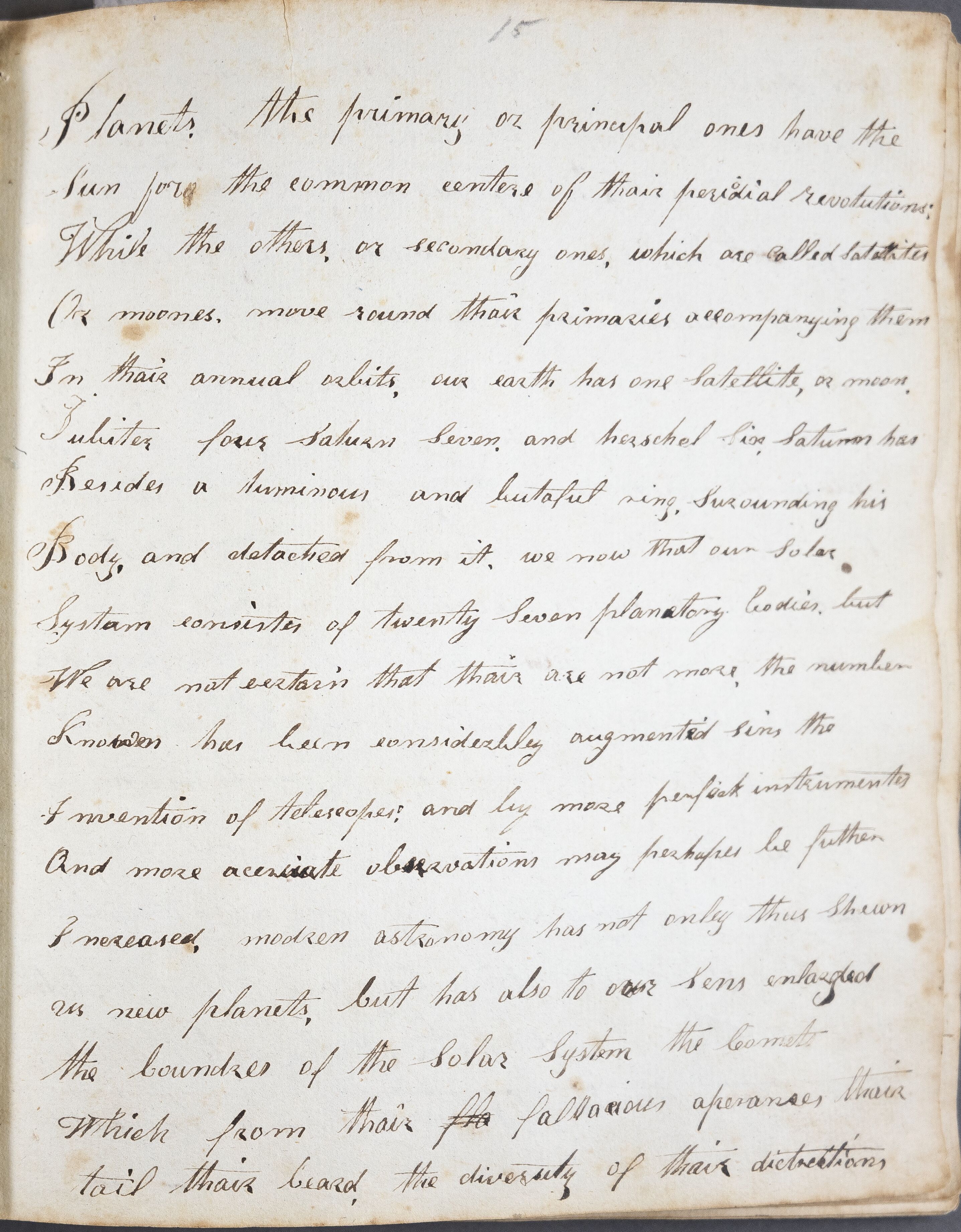
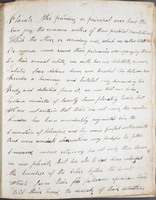
Samuel Hadlock Jr.'s Journal, Europe, 1824-1826, page 23
Planets the primary or principal ones have the
Sun for the common centers of thair [their] periodial [periodic] revolutions;
Which the others, or secondary ones, which are called satellites
Or moones [moons], move round thair [their] primaries accompanying them
In thair [their] annual orbits, our earth has one Satelite [satellite], or moon,
Jubiter [Jupiter] four Saturn seven, and herschel [Herschel] six Saturn has
Besides a luminous and butaful [beautiful] ring, surrounding [surrounding] his
Body, and detached from it, we now [know] that our Soler [solar]
Systam [system] consistes [consists] of twenty seven planatory bodies, but
We are not certain that thair [there]are not more, the number
Known has been considerabiley [considerably] augmented sins [since] the
Invention of telescopes and by more perfick [perfect] instrumentes [instruments]
And more accuiate [accurate] observations my perhapes [perhaps] be futher [further]
Increased, modern [modern] astronomy has not onley [only] thus shewn [shown]
Us new planets, but has also to our sens [sense] enlarged
The boundres [boundaries] of the Solar System the Comets
Which from thair [their] fla fallacious aperanses [appearances] thair [their]
tail thair [their] beard [?] the diversity of thair [their] dictrections [directions]
Sun for the common centers of thair [their] periodial [periodic] revolutions;
Which the others, or secondary ones, which are called satellites
Or moones [moons], move round thair [their] primaries accompanying them
In thair [their] annual orbits, our earth has one Satelite [satellite], or moon,
Jubiter [Jupiter] four Saturn seven, and herschel [Herschel] six Saturn has
Besides a luminous and butaful [beautiful] ring, surrounding [surrounding] his
Body, and detached from it, we now [know] that our Soler [solar]
Systam [system] consistes [consists] of twenty seven planatory bodies, but
We are not certain that thair [there]are not more, the number
Known has been considerabiley [considerably] augmented sins [since] the
Invention of telescopes and by more perfick [perfect] instrumentes [instruments]
And more accuiate [accurate] observations my perhapes [perhaps] be futher [further]
Increased, modern [modern] astronomy has not onley [only] thus shewn [shown]
Us new planets, but has also to our sens [sense] enlarged
The boundres [boundaries] of the Solar System the Comets
Which from thair [their] fla fallacious aperanses [appearances] thair [their]
tail thair [their] beard [?] the diversity of thair [their] dictrections [directions]
U. S. National Park Service
Samuel Hadlock of Islesford, Maine, documented his travels in Europe, where he exhibited a group of Inuit and Romani people as entertainment.
Permission must be secured from the individual copyright owners to reproduce any copyrighted materials contained within this website.
Patrick Kark
Restrictions apply on use and/or reproduction
Image
Acadia National Park, Code: ACAD
Acadia National Park, Maine
Latitude: 44.3593788146973, Longitude: -68.2397308349609
Latitude: 44.3593788146973, Longitude: -68.2397308349609
NPS Museum Catalog Number : ACAD_30972
Title: William Otis Sawtelle Collection 1692-1941
URL: https://npgallery.nps.gov/ACAD/SearchResults?collection=Acadia+National+Park+William+Otis+Sawtelle+Collection+1692-1941&view=grid&PageSize=24
Title: William Otis Sawtelle Collection 1692-1941
URL: https://www.nps.gov/acad/learn/historyculture/collections.htm
URL: https://npgallery.nps.gov/ACAD/SearchResults?collection=Acadia+National+Park+William+Otis+Sawtelle+Collection+1692-1941&view=grid&PageSize=24
Title: William Otis Sawtelle Collection 1692-1941
URL: https://www.nps.gov/acad/learn/historyculture/collections.htm
20211123
01/01/1824 - 12/30/1825
Bound journal; Manuscript
Box 24/Folder3
Public Can View
Person: Curator
Organization: US National Park Service
Address: Acadia National Park, Bar Harbor ME
Email: Acadia_Collections@nps.gov
Organization: US National Park Service
Address: Acadia National Park, Bar Harbor ME
Email: Acadia_Collections@nps.gov
Thursday, May 11, 2023 8:40:17 PM
Thursday, May 11, 2023 8:40:17 PM
ACADhadlock2_23.tif
tif
31.8 MB
Historic