Select Item below to DOWNLOAD - Once item is selected, right click and choose 'save as'

9bd65e8d-6933-4287-8ed6-d0ae3a349c10
67. Gallantry at Gettysburg by A.P. Andrews October 19, 1973_Page_10
White paper with typed black text
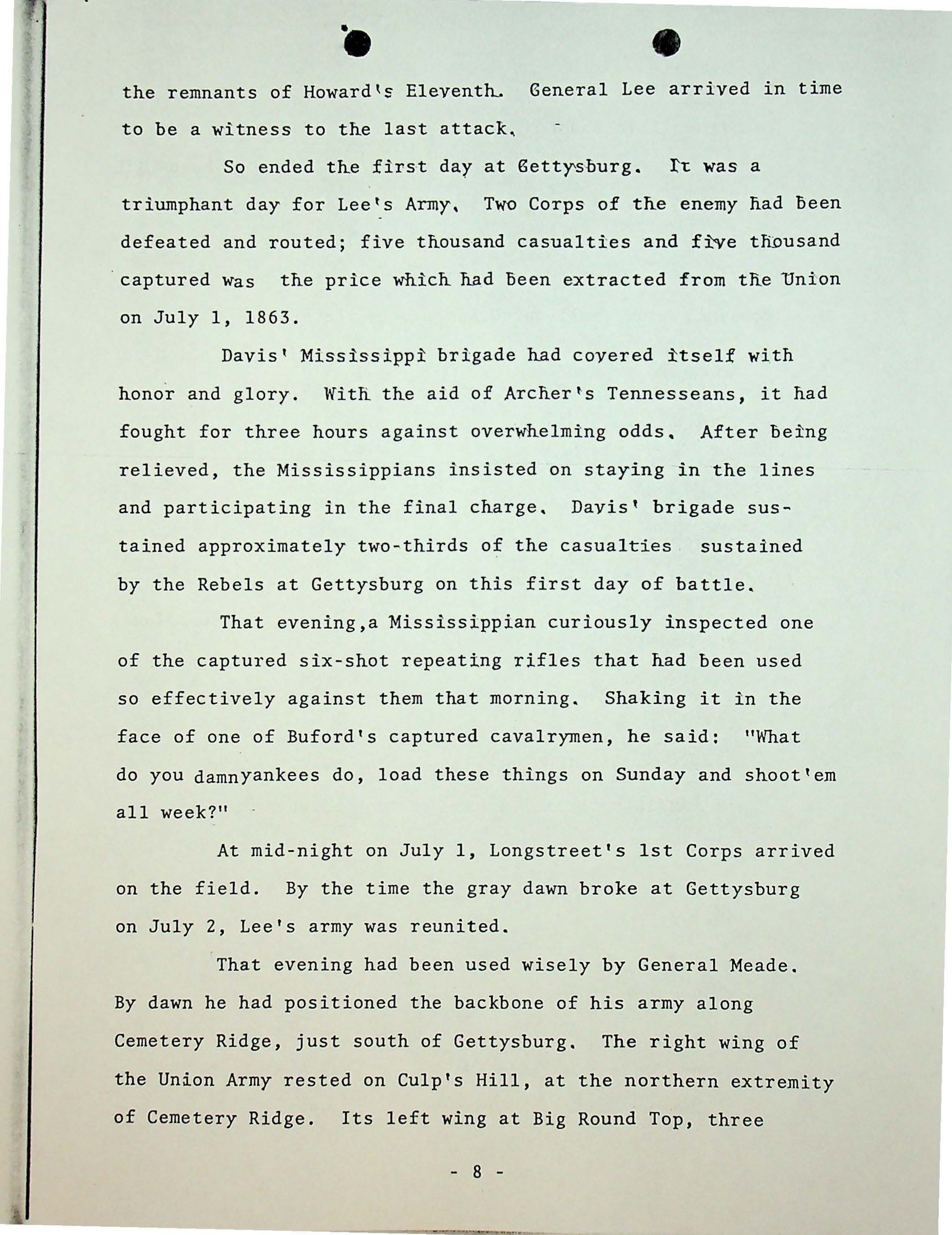
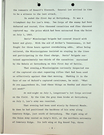
the remnants of Howard’s Eleventh. General Lee arrived in time to be a witness to the last attack.
So ended the first day at Gettysburg. It was a triumphant day for Lee’s Army. Two Corps of the enemy had been defeated and routed; five thousand casualties and five thousand captured was the price which had been extracted from the Union on July 1, 1863.
Davis’ Mississippi brigade had covered itself with honor and glory. With the aid of Archer’s Tennesseans, it had fought for three hours against and overwhelming odds. After being relieved, the Mississippians insisted on staying in the lines and participating in the final charge. Davis’ brigade sustained approximately two-thirds of the casualties sustained by the Rebels at Gettysburg on this first day of battle.
That evening, a Mississippian curiously inspected one of the captured six-shot repeating rifles that had been used so effectively against them that morning. Shaking it in the face of one of Buford’s captured cavalrymen, he said: “What do you damn yankees do, load these things on Sunday and shoot ‘em all week?”
At mid-night on July 1, Longstreet’s 1st Corps arrived on the field. By the time the gray dawn broke at Gettysburg on July 2, Lee’s army was reunited.
That evening had been used wisely by General Meade. By dawn he had positioned the backbone of his army along Cemetery Ridge, just south of Gettysburg. The right wing of the Union Army rested on Culp’s Hill, at the northern extremity of Cemetery Ridge. Its left wing at Big Round Top, three
Permission must be secured from the individual copyright owners to reproduce any copyrighted materials contained within this website. Digital assets without any copyright restrictions are public domain.
NPS Photo
Public domain:Full Granting Rights
Image
Gettysburg National Military Park, Code: GETT
Gettysburg National Military Park, Adams County, Pennsylvania
Latitude: 39.804500579834, Longitude: -77.2384033203125
Latitude: 39.804500579834, Longitude: -77.2384033203125
09/01/2021 | Wednesday, September 1, 2021
01/01/0001
Public Can View
Friday, March 11, 2022 7:40:14 AM
Monday, March 14, 2022 1:49:41 PM
67. Gallantry at Gettysburg by A.P. Andrews October 19, 1973_Page_10.jpg
Monday, January 1, 0001 12:00:00 AM
jpg
385.1 kB
Scenic