Select Item below to DOWNLOAD - Once item is selected, right click and choose 'save as'


6fa44d1f-54f7-4dfe-a292-00d62cde8a88
Frances (Appleton) Longfellow to Reverend Samuel Longfellow, 10 May 1852
Manuscript letter
Cambridge May 10th 1852
Dear Sam,
It seems very long since we have heard from you but I know what anxieties you have had & I truly grieve they should have fallen upon you. As Uncle Wm’s in Washington I have only heard of Charley’s illness at secondhand from Mrs Coolidge & I shall hope soon to learn from yourself what you think of his state. I am thankful he is better, for his poor parents have had woes enough. His sister Mrs Greene is still upon her bed, as she was a year ago, but they hope to get her on board ship to strengthen her by the change & her father is on his way here to help accomplish it. I shall hear from him your plans I trust.
From the depth of winter we have [p. 2] suddenly burst into full summer verdure; in three days the bare boughs were clothed with green. Kossuth's coming seems to have produced this miracle as his genial presence makes blossom many a wintry heart and conquers many a prejudice. He was shamefully abused in most of the ''bunker'' papers before he came, but no one can fail to listen to him with respect & sympathy, however hopeless they may consider his cause. We have seen him several times delightfully. We first met the Pulszky’s (his Secretary of State & a man of wonderful information & intelligence) at a party at Mr Chas G. Lorings & were charmed with them. Madame P. has a face of animated beauty & is very clever & agreeable. We called upon them and & introduced to Kossuth after hearing him address a committee from Salem in his drawing-room. He took Henry most warmly by both hands & said, "Tho I am not a man of genius, I know how to appreciate one." He has a fine, graceful figure & noble countenance, especially when kindled by speaking – great dignity of manner [p. 3] & is usually rather grave & silent, but what he says with his deep musical voice is always freighted with thought or feeling. We dined with him on Sunday at Dr Howes, quite by ourselves, & I sat next him, but felt such an awe, thinking of all he had suffered & done, I could not speak much. Madame Kossuth is tall with fine eyes, but drooping with much weeping, & her face tells a tale of anxiety & sorrow. Her health has suffered much, but the Pulszky’s are full of freshness & life & seem ready to go through all again. Madame P. said to me, “Kossuth is the great man of the century. I have seen him now under every variety of circumstance & always the same greatness – never a thought of self – he sacrifices everything for his country.” I said, "His enemies acknowledge his greatness by their fears of him." To which she replied, “Yes they know his ability, but not his character.”
Tuesday last was Exhibition, and the Pulszky’s came out & went with us. Kossuth had been invited by the President, but declined, having to speak every day in some new town, but just as the last oration was half through [p. 3] he came. We heard the shouts of welcome as we sat in the Chapel. The young man paused & retired, Henry & Felton escorted him & Madame in at the North door, Gov Boutwell & his suite following. As he appeared on the platform in his black velvet frock coat & plumed beaver, such hurrahs as only students can give roared through the densely packed room. He smiled & bowed slightly, then sat down. The young man finished his theme "On unsuccessful great men" very appropriately handled,” & when it was over, Mr Sparks descended to welcome the noble guest, & begged him to address the students. He at first declined but being introduced to them by the President stood forth & said a few words. He then drove directly to our house where he remained half an hour, sitting down in the study, after being received in the Library, & putting an arm around Charley & Erny, asked them to recite one of their papa's poems, but alasl it was not forthcoming! He then drove to Dr Lowell’s who prayed over him with much feeling & then to Mr Sparks & Mr Chas Lowells (these on account of Mrs Putnam) but could not return to dine with us. The Pulszkys did (with Dr Beck Agassiz Felton & the Nortons,) & in the ev’g we took them to a party for them at Mrs Chas Lowells & so ended this interesting day.
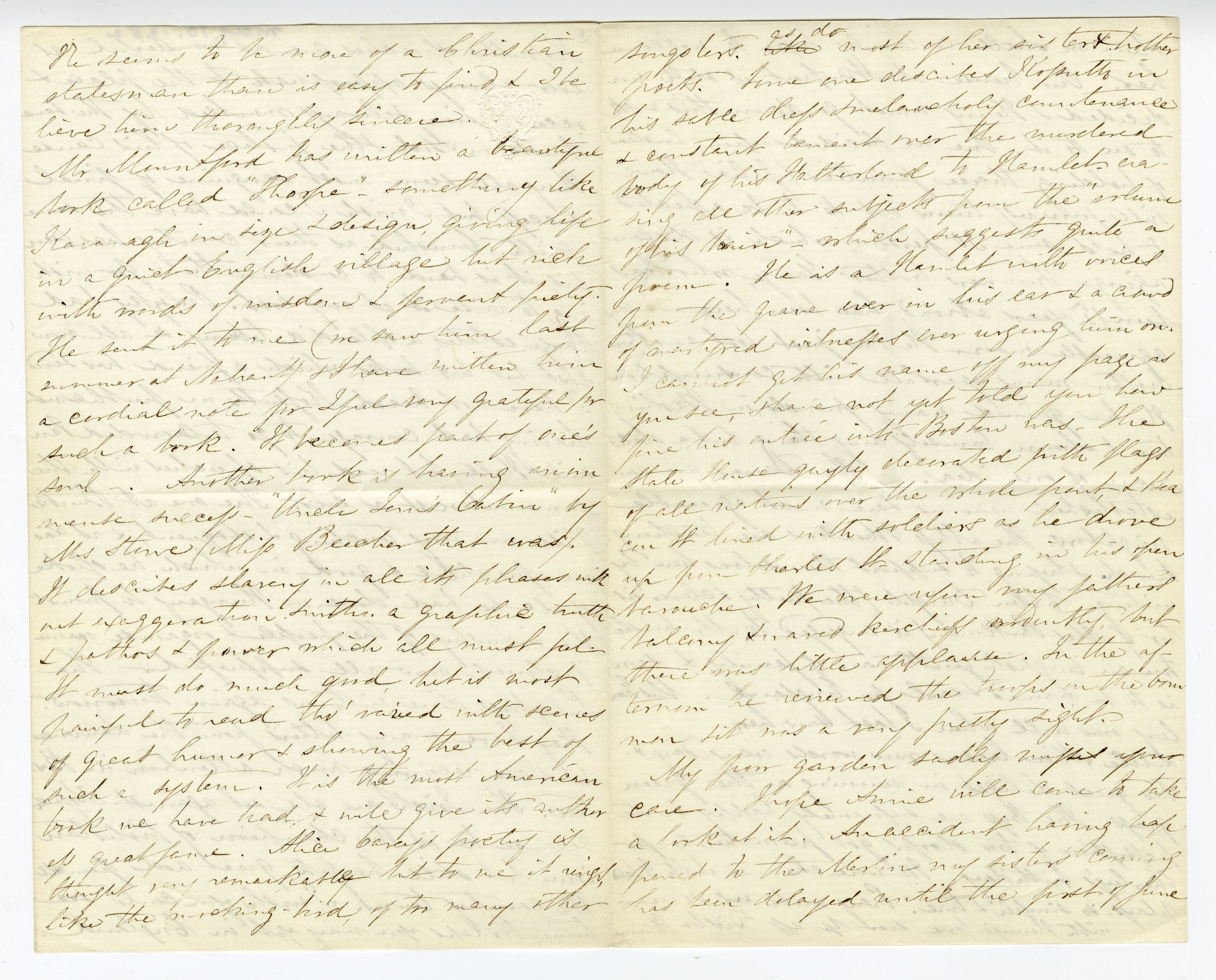
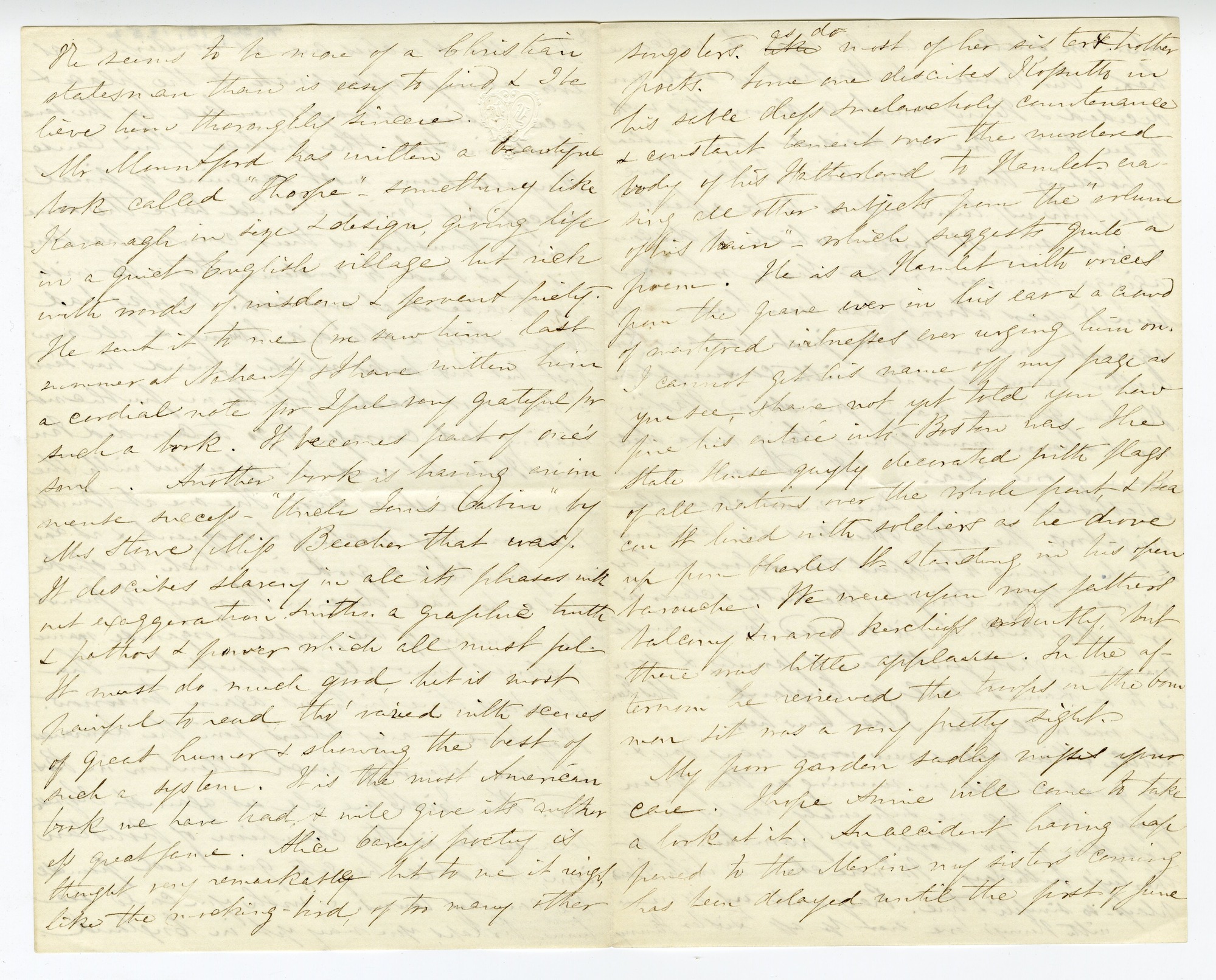
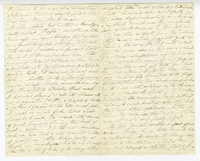
[p. 5 marked 2] Kossuth's speeches are as wonderful as ever always appropriate to the place & occasion & always marked by the same trust in God & the justice of his cause. They all seem most sanguine of final success, but I wish I could have the same faith. Crushed as their country has been & is, it is hard to condemn them for wishing to raise it at any cost. Pulszky had large estates, a splendid library &c all now lost but his books, which a friend has saved. I have not heard Kossuth in public not having had courage to go to crowded Faneuil Hall, but read his speeches with the same interest as ever. The one at Bunker Hill was very touching & eloquent, & at Lowell practical & good, in which he spoke of all he had done in Hungary to promote the industry of the people & organize manufactories – now all suppressed. the Pulszkys dine with us again tomorrow. They have many letters from the Lawrence’s &c & are receiving much attention in Boston. The Irish are all set against Kossuth because he is the champion of Protestantism, but still he gets great aid from all the country towns. I wish you could see him. Perhaps you may yet in England. [p. 6] He seems to be more of a Christian statesman than is easy to find, & I believe him thoroughly sincere.
Mr Mountford has written a beautiful book called “Thorpe” – something like Kavanagh in size & design, giving life in a quiet English village but rich with words of wisdom & fervent piety. He sent it to me (we saw him last summer at Nahant) & I have written him a cordial note for I feel very grateful for such a book. It becomes part of one’s soul.
Another book is having immense success – “Uncle Tom’s Cabin” by Mrs Stowe (Miss Beecher that was). It describes slavery in all its phases without exaggeration & with a graphic truth & pathos & power which all must feel. It must do much good, but is most painful to read, tho’ varied with scenes of great humor & showing the best of such a system. It is the most American book we have had & will give its authoress great fame. Alice Cary’s poetry is thought very remarkable but to me it rings, like the mocking-bird, of too many other [p. 7] songsters. [crossed out: like] as do most of her sister & brother poets. Some one describes Kossuth in his sable dress & melancholy countenance & constant lament over the murdered body of his Fatherland to Hamlet – erasing all other subjects from the “volume of his brain” – which suggests quite a poem. He is a Hamlet with voices from the grave ever in his ear & a crowd of martyred witnesses ever urgin him on. I cannot get his name off my page as you see, & have not yet told you how fine his entrée into Boston was – The State House gayly decorated with flags of all nations over the whole front, & Beacon St lined with soldiers as he drove up from Charles St. standing in his open barouche. We were upon my father’s balcony & waved kerchiefs ardently, but there was little applause. In the afternoon he reviewed the troops on the Common & it was a very pretty sight.
My poor garden sadly misses your care. I hope Annie will come to take a look at it. An accident having happened to the Merlin my sister’s coming has been delayed until the first of June [p. 8] when we shall certainly hope to welcome her. Our house at Newport is still undecided & Henry must go down this week to see to it. One we decided upon instead of holding three families (Julia Howe will join us) turns out to be expected to hold some 30 persons,! which is discouraging. Sumner’s brother George, who has been 15 years abroad, has been here – a very agreeable man. He has just lost another brother many years ill with consumption. He has gained many friends in Washington & shown himself any thing but a statesman of one idea. The Danas are now established near us, & are most agreeable neighbors. The Miss Wheaton’s are teaching French & trying to support themselves here by writing. Ellen Dwight (the pretty & clever sister of Mrs Parkman) is engaged to Mr Twisleton an English gentleman of family, & soon is to be married & sail to England. Mrs Greenleaf was well when I last saw her.
Little Alice learns new words every day & has great delight in running on the green grass. The boys are supremely happy in the possession of two sloops got prematurely for Charley’s birthday. We were charmed with G. Sand’s plays – so simple & true. Pray write us soon.
with Henry’s love ever yr affte sister Fanny.
Dear Sam,
It seems very long since we have heard from you but I know what anxieties you have had & I truly grieve they should have fallen upon you. As Uncle Wm’s in Washington I have only heard of Charley’s illness at secondhand from Mrs Coolidge & I shall hope soon to learn from yourself what you think of his state. I am thankful he is better, for his poor parents have had woes enough. His sister Mrs Greene is still upon her bed, as she was a year ago, but they hope to get her on board ship to strengthen her by the change & her father is on his way here to help accomplish it. I shall hear from him your plans I trust.
From the depth of winter we have [p. 2] suddenly burst into full summer verdure; in three days the bare boughs were clothed with green. Kossuth's coming seems to have produced this miracle as his genial presence makes blossom many a wintry heart and conquers many a prejudice. He was shamefully abused in most of the ''bunker'' papers before he came, but no one can fail to listen to him with respect & sympathy, however hopeless they may consider his cause. We have seen him several times delightfully. We first met the Pulszky’s (his Secretary of State & a man of wonderful information & intelligence) at a party at Mr Chas G. Lorings & were charmed with them. Madame P. has a face of animated beauty & is very clever & agreeable. We called upon them and & introduced to Kossuth after hearing him address a committee from Salem in his drawing-room. He took Henry most warmly by both hands & said, "Tho I am not a man of genius, I know how to appreciate one." He has a fine, graceful figure & noble countenance, especially when kindled by speaking – great dignity of manner [p. 3] & is usually rather grave & silent, but what he says with his deep musical voice is always freighted with thought or feeling. We dined with him on Sunday at Dr Howes, quite by ourselves, & I sat next him, but felt such an awe, thinking of all he had suffered & done, I could not speak much. Madame Kossuth is tall with fine eyes, but drooping with much weeping, & her face tells a tale of anxiety & sorrow. Her health has suffered much, but the Pulszky’s are full of freshness & life & seem ready to go through all again. Madame P. said to me, “Kossuth is the great man of the century. I have seen him now under every variety of circumstance & always the same greatness – never a thought of self – he sacrifices everything for his country.” I said, "His enemies acknowledge his greatness by their fears of him." To which she replied, “Yes they know his ability, but not his character.”
Tuesday last was Exhibition, and the Pulszky’s came out & went with us. Kossuth had been invited by the President, but declined, having to speak every day in some new town, but just as the last oration was half through [p. 3] he came. We heard the shouts of welcome as we sat in the Chapel. The young man paused & retired, Henry & Felton escorted him & Madame in at the North door, Gov Boutwell & his suite following. As he appeared on the platform in his black velvet frock coat & plumed beaver, such hurrahs as only students can give roared through the densely packed room. He smiled & bowed slightly, then sat down. The young man finished his theme "On unsuccessful great men" very appropriately handled,” & when it was over, Mr Sparks descended to welcome the noble guest, & begged him to address the students. He at first declined but being introduced to them by the President stood forth & said a few words. He then drove directly to our house where he remained half an hour, sitting down in the study, after being received in the Library, & putting an arm around Charley & Erny, asked them to recite one of their papa's poems, but alasl it was not forthcoming! He then drove to Dr Lowell’s who prayed over him with much feeling & then to Mr Sparks & Mr Chas Lowells (these on account of Mrs Putnam) but could not return to dine with us. The Pulszkys did (with Dr Beck Agassiz Felton & the Nortons,) & in the ev’g we took them to a party for them at Mrs Chas Lowells & so ended this interesting day.
[p. 5 marked 2] Kossuth's speeches are as wonderful as ever always appropriate to the place & occasion & always marked by the same trust in God & the justice of his cause. They all seem most sanguine of final success, but I wish I could have the same faith. Crushed as their country has been & is, it is hard to condemn them for wishing to raise it at any cost. Pulszky had large estates, a splendid library &c all now lost but his books, which a friend has saved. I have not heard Kossuth in public not having had courage to go to crowded Faneuil Hall, but read his speeches with the same interest as ever. The one at Bunker Hill was very touching & eloquent, & at Lowell practical & good, in which he spoke of all he had done in Hungary to promote the industry of the people & organize manufactories – now all suppressed. the Pulszkys dine with us again tomorrow. They have many letters from the Lawrence’s &c & are receiving much attention in Boston. The Irish are all set against Kossuth because he is the champion of Protestantism, but still he gets great aid from all the country towns. I wish you could see him. Perhaps you may yet in England. [p. 6] He seems to be more of a Christian statesman than is easy to find, & I believe him thoroughly sincere.
Mr Mountford has written a beautiful book called “Thorpe” – something like Kavanagh in size & design, giving life in a quiet English village but rich with words of wisdom & fervent piety. He sent it to me (we saw him last summer at Nahant) & I have written him a cordial note for I feel very grateful for such a book. It becomes part of one’s soul.
Another book is having immense success – “Uncle Tom’s Cabin” by Mrs Stowe (Miss Beecher that was). It describes slavery in all its phases without exaggeration & with a graphic truth & pathos & power which all must feel. It must do much good, but is most painful to read, tho’ varied with scenes of great humor & showing the best of such a system. It is the most American book we have had & will give its authoress great fame. Alice Cary’s poetry is thought very remarkable but to me it rings, like the mocking-bird, of too many other [p. 7] songsters. [crossed out: like] as do most of her sister & brother poets. Some one describes Kossuth in his sable dress & melancholy countenance & constant lament over the murdered body of his Fatherland to Hamlet – erasing all other subjects from the “volume of his brain” – which suggests quite a poem. He is a Hamlet with voices from the grave ever in his ear & a crowd of martyred witnesses ever urgin him on. I cannot get his name off my page as you see, & have not yet told you how fine his entrée into Boston was – The State House gayly decorated with flags of all nations over the whole front, & Beacon St lined with soldiers as he drove up from Charles St. standing in his open barouche. We were upon my father’s balcony & waved kerchiefs ardently, but there was little applause. In the afternoon he reviewed the troops on the Common & it was a very pretty sight.
My poor garden sadly misses your care. I hope Annie will come to take a look at it. An accident having happened to the Merlin my sister’s coming has been delayed until the first of June [p. 8] when we shall certainly hope to welcome her. Our house at Newport is still undecided & Henry must go down this week to see to it. One we decided upon instead of holding three families (Julia Howe will join us) turns out to be expected to hold some 30 persons,! which is discouraging. Sumner’s brother George, who has been 15 years abroad, has been here – a very agreeable man. He has just lost another brother many years ill with consumption. He has gained many friends in Washington & shown himself any thing but a statesman of one idea. The Danas are now established near us, & are most agreeable neighbors. The Miss Wheaton’s are teaching French & trying to support themselves here by writing. Ellen Dwight (the pretty & clever sister of Mrs Parkman) is engaged to Mr Twisleton an English gentleman of family, & soon is to be married & sail to England. Mrs Greenleaf was well when I last saw her.
Little Alice learns new words every day & has great delight in running on the green grass. The boys are supremely happy in the possession of two sloops got prematurely for Charley’s birthday. We were charmed with G. Sand’s plays – so simple & true. Pray write us soon.
with Henry’s love ever yr affte sister Fanny.
Archives Number: 1011/002.001-022#013
U. S. National Park Service
Permission must be secured from the individual copyright owners to reproduce any copyrighted materials contained within this website.
Public domain
Correspondence (1011/002), (LONG-SeriesName)
, Letters from Frances Longfellow (1011/002.001), (LONG-SubseriesName)
, 1852 (1011/002.001-022), (LONG-FileUnitName)
, Letters from Frances Longfellow (1011/002.001), (LONG-SubseriesName)
, 1852 (1011/002.001-022), (LONG-FileUnitName)
Image
Longfellow House - Washington's Headquarters National Historic Site, Code: LONG
Longfellow House - Washington's Headquarters National Historic Site, Middlesex County, Massachusetts
Latitude: 42.3769989013672, Longitude: -71.1264038085938
Latitude: 42.3769989013672, Longitude: -71.1264038085938
NPS Museum Number Catalog : LONG 20257
Title: Finding Aid to the Frances Elizabeth Appleton Longfellow (1817-1861) Papers, 1825-1961 (bulk dated: 1832-1861)
URL: https://www.nps.gov/long/learn/historyculture/archives.htm#FEAL
URL: https://www.nps.gov/long/learn/historyculture/archives.htm#FEAL
2016-01-30
05/10/1852
Manuscript letter in Frances Appleton Longfellow Papers, Series II. Correspondence, A. Outgoing, 1852. (1011/002.001-022#013)
Public Can View
Organization: Longfellow House-Washington's Headquarters National Historic Site
Address: 105 Brattle Street, Cambridge, MA 02138
Email: LONG_archives@nps.gov
Address: 105 Brattle Street, Cambridge, MA 02138
Email: LONG_archives@nps.gov
Wednesday, November 9, 2022 5:39:04 PM
Wednesday, November 9, 2022 5:39:04 PM
1011-02-01-22-13 p6+7.jpg
jpg
2.5 MB
Historic