Select Item below to DOWNLOAD - Once item is selected, right click and choose 'save as'

cff131c3-2f39-45b1-aa34-78d46539b251
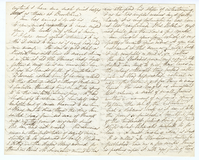
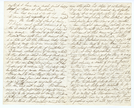
Frances (Appleton) Longfellow to Emmeline (Austin) Wadsworth, 28 June 1850
Manuscript letter
Cambridge Friday. 1850.
Dearest friend,
Your letter was welcomed last night, & I hope you do not think I have been waiting for one to write – no, the will was many times urgent since you departed, but the heat made me so languid & faint for some days that I could do nothing but lie flat on my back, & some imperative letters have exhausted the little writing capability I had left.
I was sorely disappointed not to see you again, but supposed you must have been prevented by something or somebody, & confess the day I was with you was so precious to me that I felt very unamiably towards both Anna T- & Miss Grant for so abridging our intercourse, but I cannot expect my selfish claims to be always acknowledged by others. I will not despair yet that we may some day enjoy each other to our hearts [p. 2] content, & have some such quiet, happy [crossed out: stays] hours as those at Brookline.
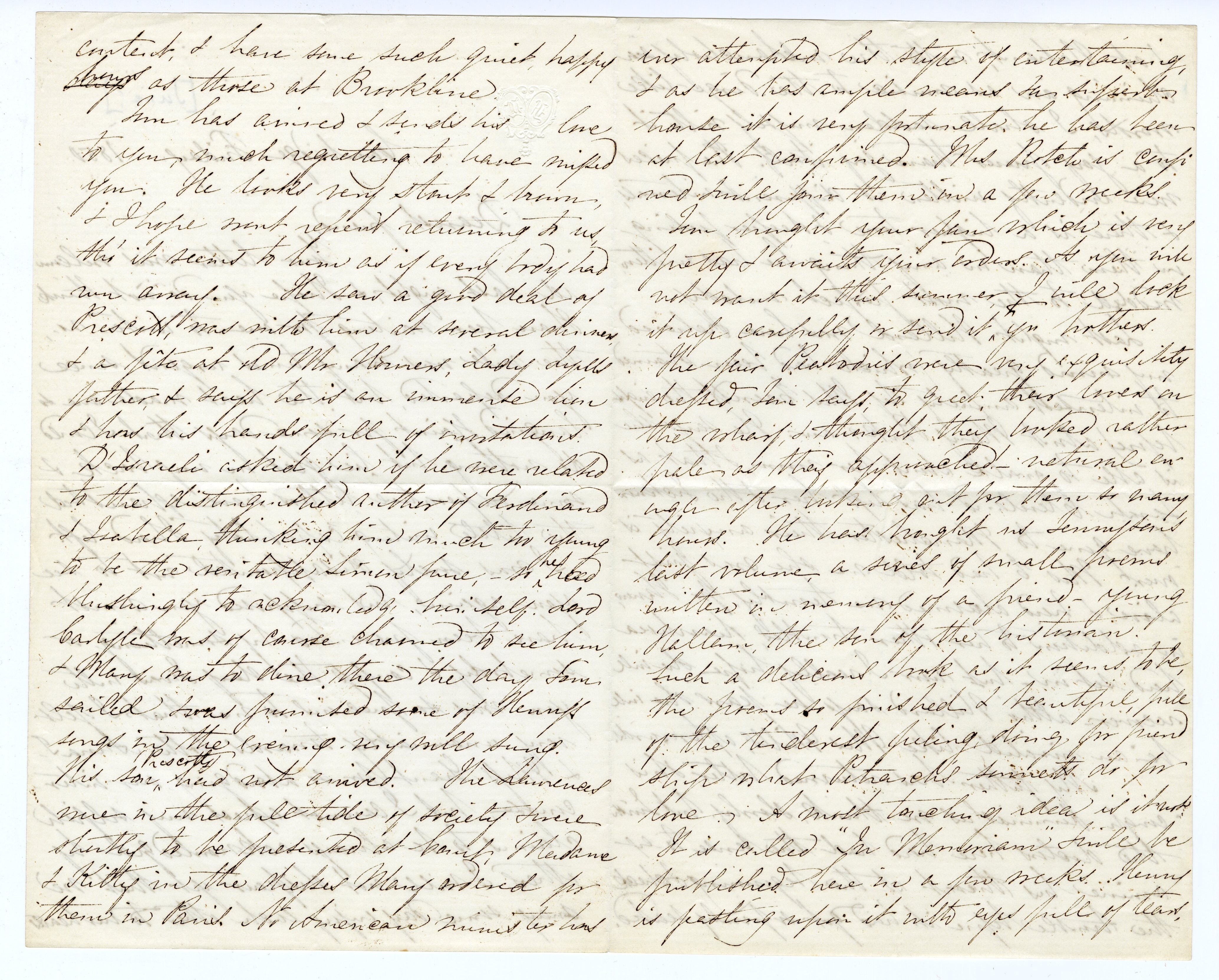
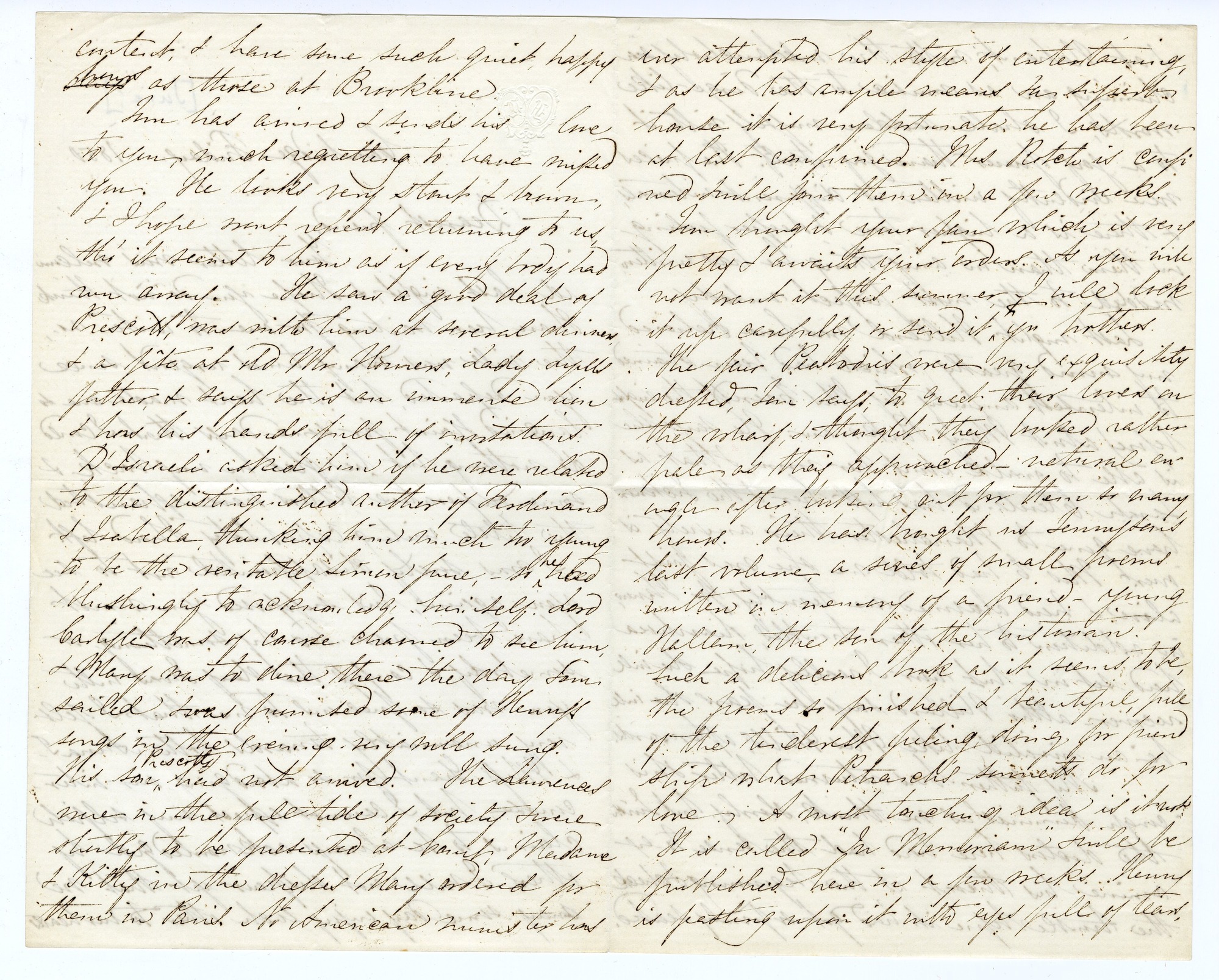
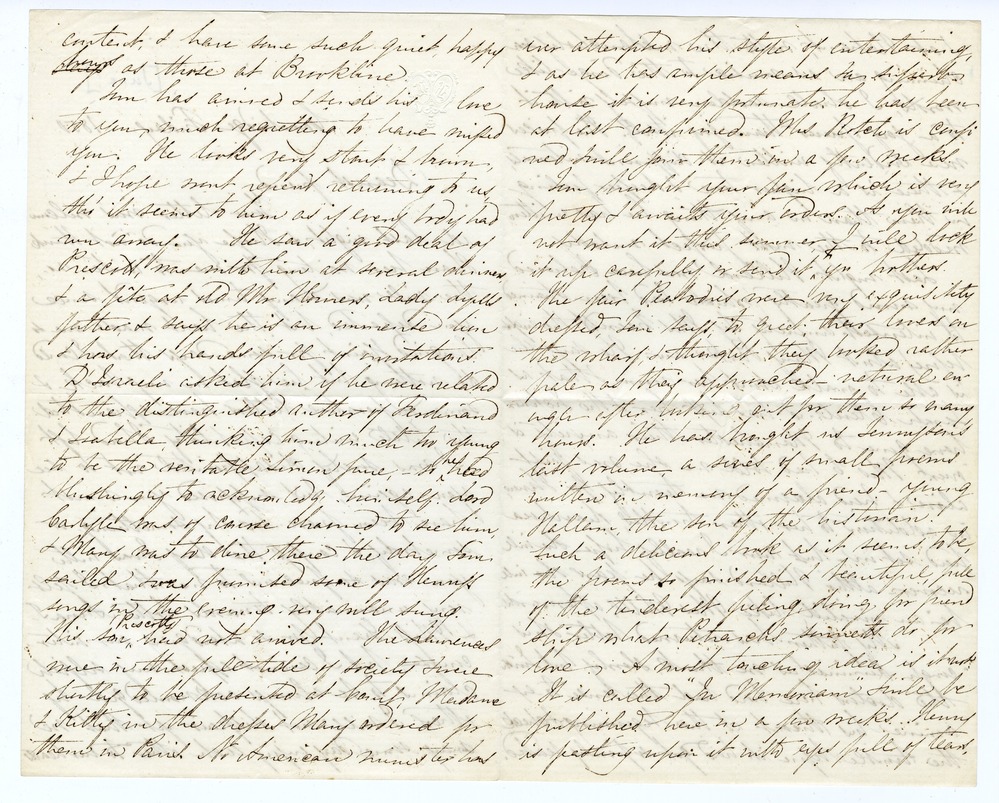
Tom has arrived & sends his love to you, much regretting to have missed you. He looks very stout & brown, & I hope wont repent returning to us, tho’ it seems to him as if every body had run away. He saw a good deal of Prescott, was with him at several dinners, & a fête at old Mr Homers, Lady Lyells father, & says he is an immense lion & has his hands full of invitations. D’Israeli asked him if he were related to the distinguished author of Ferdinand & Isabella, thinking him much too young to be the veritable Simon pure, - so his had blushingly to acknowledge himself. Lord Carlyle was of course charmed to see him, & Mary was to dine there the day Tom sailed & was promised some of Henry’s songs in the evening – very well sung. His son (Prescott) had not arrived. The Lawrences were in the full tide of society & were shortly to be presented at Court, Madame & Kitty in the dresses Mary ordered for them in Paris. No American minister has [p. 3] ever attempted his style of entertaining, & as he has ample means & a superb house it is very fortunate. he has been at last confirmed. Mrs Rotch is confined & will join them in a few weeks.
Tom brought your fan which is very pretty & awaits your orders. As you will not want it this summer, I will lock it up carefully or send it to yr brothers. The fair Peabodies were very exquisitely dressed, Tom says, to greet their loves on the wharf, & thought they looked rather pale as they approached! – natural enough after looking out for them so many hours. He has brought us Tennyson’s last volume, a series of small poems written in memory of a friend – young Hallam, the son of the historian. Such a delicious book as it seems to be, the poems so finished & beautiful, full of the tenderest feeling, doing for friendship what Petrarch’s sonnets do for love. A most touching idea is it not? It is called “In Memoriam” & will be published here in a few weeks. Henry is feasting upon it with eyes full of tears, [p. 4] & at Nahant, with the melancholy sea chiming in as music to the dirge-like words, I shall sadden myself with it to a joy purer than joy itself. The pieces were evidently written at different intervals, & there is a higher tone & deeper feeling in them than in any thing he has written, wedded to the most perfect melody.
Last night Hillard was here & delivered my mind greatly (which had been strained to intensest anxiety by Mrs Everett the night before) about Mary Parkman. He says she is able to walk about her room, & that as Sarah Cleveland has left her & the Ticknors have gone to Manchester their anxiety is over. Mrs E. had told me she was just alive, & had alarmed me terribly, for I knew, in addition to her other troubles, diarrhoea had set in – but now I really hope she will recover – altho’ Hillard says he fears she will be an invalid, like Mrs Mills; afterwards.
My father has returned better & his cough diminishes we think, slowly, but I wish the doctors here had had the sense to examine his throat at the beginning & check the trouble before it had got so firmly seated. [p. 5 marked 2, pencil “1850”] He goes to Pittsfield the 5th of July & we to Nahant on the 3d. Tom will, I hope, be contented to share our tenfooter, but I fear we cannot keep him long at a time as he is restless & will probably wish to take a look at Newport. He was much grieved to hear of your brothers death. – As Harriot seems determined to expel him the mansion (she once gave a pleasant finale to one of my visits by saying I could not come again as she could not have Tom incommoded! – I had driven him out of his room) I hope he & Edward may combine forces for a bachelor establishment, but I have not had the heart to speak of it yet & shan’t until he opens the subject.
Class Day has gone by with its usual festivities all of which I eschewed, not feeling equal to the fatigue of such things tho’ very well in the main. Dr & Mrs Frothingham came to see me, the other evening, & expressed great regret at not seeing you again. She seemed to have had some expectations of a christening, but I told her the sad news which had so [p. 6] absorbed your last week, & they were very sorry they did not call to see you. He seems to enjoy his country quiet, but looks very poorly I think. Poor Mr Daniel P. Parker is very ill, & it is thought doubtful if he can live many weeks. Mr John H. Grey, who married Miss Tucker, has died at Nahant, after a short illness.
Rogers, the poet, was knocked down by a cab, returning from some dinner, (he will always walk), & is in a critical state. That would be a sad termination of a life of such ease & elegant comfort!
I have been reading Mrs Ellet’s “Women of the Revolution”, & have found it very interesting, giving vivid portraits of most heroic women & the days of the Revolution a reality they never had to me before. She has a short notice of Henry’s grandmother, the wife of General Wadsworth, & many others more fully – It is amazing what women were virved to do in the enthusiasm & urgency of those days of trial, - & there are a vast many most romantic incidents – besides the number [p. 7] unrecorded & forgotten.
Henry is the victim, just now, of two artists. Your old friend Giovanni Thompson paints him all the morning (for his own satisfaction) & a young Scotchman models his profile in clay all the afternoon. The latter, Shakspere Wood by name, is an intolerable bore, always remaining to tea. & well into the evening. I am heartily weary of his tiresome talk, & shall be thankful when he departs. Henry is resolved never to be so good natured again
How beautifully Geneseo must be looking, for I think the foliage is remarkably fine this year. I sit at my Library window & greatly enjoy even my small patch of ground, the children tumbling in the hay-cocks & the birds rejoicing in the trees.
Your chicks I hope will fatten fast upon the good weather & open air & grow rosy & strong. Elisabeth’s fair presence must haunt all your vacant rooms, but it is well, perhaps, she has left you so much to do in keeping up her establishment. Give my love to [p. 8] William – who must have been greatly comforted to see you back again & will, I trust, grow stronger to enjoy his happiness. It will be almost like your first married housekeeping!
I have written more than I should & must come to an end. With kind regards to Mrs James - & much love from Henry to yourself,
ever thy faithful
Fanny
Dearest friend,
Your letter was welcomed last night, & I hope you do not think I have been waiting for one to write – no, the will was many times urgent since you departed, but the heat made me so languid & faint for some days that I could do nothing but lie flat on my back, & some imperative letters have exhausted the little writing capability I had left.
I was sorely disappointed not to see you again, but supposed you must have been prevented by something or somebody, & confess the day I was with you was so precious to me that I felt very unamiably towards both Anna T- & Miss Grant for so abridging our intercourse, but I cannot expect my selfish claims to be always acknowledged by others. I will not despair yet that we may some day enjoy each other to our hearts [p. 2] content, & have some such quiet, happy [crossed out: stays] hours as those at Brookline.
Tom has arrived & sends his love to you, much regretting to have missed you. He looks very stout & brown, & I hope wont repent returning to us, tho’ it seems to him as if every body had run away. He saw a good deal of Prescott, was with him at several dinners, & a fête at old Mr Homers, Lady Lyells father, & says he is an immense lion & has his hands full of invitations. D’Israeli asked him if he were related to the distinguished author of Ferdinand & Isabella, thinking him much too young to be the veritable Simon pure, - so his had blushingly to acknowledge himself. Lord Carlyle was of course charmed to see him, & Mary was to dine there the day Tom sailed & was promised some of Henry’s songs in the evening – very well sung. His son (Prescott) had not arrived. The Lawrences were in the full tide of society & were shortly to be presented at Court, Madame & Kitty in the dresses Mary ordered for them in Paris. No American minister has [p. 3] ever attempted his style of entertaining, & as he has ample means & a superb house it is very fortunate. he has been at last confirmed. Mrs Rotch is confined & will join them in a few weeks.
Tom brought your fan which is very pretty & awaits your orders. As you will not want it this summer, I will lock it up carefully or send it to yr brothers. The fair Peabodies were very exquisitely dressed, Tom says, to greet their loves on the wharf, & thought they looked rather pale as they approached! – natural enough after looking out for them so many hours. He has brought us Tennyson’s last volume, a series of small poems written in memory of a friend – young Hallam, the son of the historian. Such a delicious book as it seems to be, the poems so finished & beautiful, full of the tenderest feeling, doing for friendship what Petrarch’s sonnets do for love. A most touching idea is it not? It is called “In Memoriam” & will be published here in a few weeks. Henry is feasting upon it with eyes full of tears, [p. 4] & at Nahant, with the melancholy sea chiming in as music to the dirge-like words, I shall sadden myself with it to a joy purer than joy itself. The pieces were evidently written at different intervals, & there is a higher tone & deeper feeling in them than in any thing he has written, wedded to the most perfect melody.
Last night Hillard was here & delivered my mind greatly (which had been strained to intensest anxiety by Mrs Everett the night before) about Mary Parkman. He says she is able to walk about her room, & that as Sarah Cleveland has left her & the Ticknors have gone to Manchester their anxiety is over. Mrs E. had told me she was just alive, & had alarmed me terribly, for I knew, in addition to her other troubles, diarrhoea had set in – but now I really hope she will recover – altho’ Hillard says he fears she will be an invalid, like Mrs Mills; afterwards.
My father has returned better & his cough diminishes we think, slowly, but I wish the doctors here had had the sense to examine his throat at the beginning & check the trouble before it had got so firmly seated. [p. 5 marked 2, pencil “1850”] He goes to Pittsfield the 5th of July & we to Nahant on the 3d. Tom will, I hope, be contented to share our tenfooter, but I fear we cannot keep him long at a time as he is restless & will probably wish to take a look at Newport. He was much grieved to hear of your brothers death. – As Harriot seems determined to expel him the mansion (she once gave a pleasant finale to one of my visits by saying I could not come again as she could not have Tom incommoded! – I had driven him out of his room) I hope he & Edward may combine forces for a bachelor establishment, but I have not had the heart to speak of it yet & shan’t until he opens the subject.
Class Day has gone by with its usual festivities all of which I eschewed, not feeling equal to the fatigue of such things tho’ very well in the main. Dr & Mrs Frothingham came to see me, the other evening, & expressed great regret at not seeing you again. She seemed to have had some expectations of a christening, but I told her the sad news which had so [p. 6] absorbed your last week, & they were very sorry they did not call to see you. He seems to enjoy his country quiet, but looks very poorly I think. Poor Mr Daniel P. Parker is very ill, & it is thought doubtful if he can live many weeks. Mr John H. Grey, who married Miss Tucker, has died at Nahant, after a short illness.
Rogers, the poet, was knocked down by a cab, returning from some dinner, (he will always walk), & is in a critical state. That would be a sad termination of a life of such ease & elegant comfort!
I have been reading Mrs Ellet’s “Women of the Revolution”, & have found it very interesting, giving vivid portraits of most heroic women & the days of the Revolution a reality they never had to me before. She has a short notice of Henry’s grandmother, the wife of General Wadsworth, & many others more fully – It is amazing what women were virved to do in the enthusiasm & urgency of those days of trial, - & there are a vast many most romantic incidents – besides the number [p. 7] unrecorded & forgotten.
Henry is the victim, just now, of two artists. Your old friend Giovanni Thompson paints him all the morning (for his own satisfaction) & a young Scotchman models his profile in clay all the afternoon. The latter, Shakspere Wood by name, is an intolerable bore, always remaining to tea. & well into the evening. I am heartily weary of his tiresome talk, & shall be thankful when he departs. Henry is resolved never to be so good natured again
How beautifully Geneseo must be looking, for I think the foliage is remarkably fine this year. I sit at my Library window & greatly enjoy even my small patch of ground, the children tumbling in the hay-cocks & the birds rejoicing in the trees.
Your chicks I hope will fatten fast upon the good weather & open air & grow rosy & strong. Elisabeth’s fair presence must haunt all your vacant rooms, but it is well, perhaps, she has left you so much to do in keeping up her establishment. Give my love to [p. 8] William – who must have been greatly comforted to see you back again & will, I trust, grow stronger to enjoy his happiness. It will be almost like your first married housekeeping!
I have written more than I should & must come to an end. With kind regards to Mrs James - & much love from Henry to yourself,
ever thy faithful
Fanny
Archives Number: 1011/002.001-020#019
U. S. National Park Service
Permission must be secured from the individual copyright owners to reproduce any copyrighted materials contained within this website.
Public domain
Correspondence (1011/002), (LONG-SeriesName)
, Letters from Frances Longfellow (1011/002.001), (LONG-SubseriesName)
, 1850 (1011/002.001-020), (LONG-FileUnitName)
, Letters from Frances Longfellow (1011/002.001), (LONG-SubseriesName)
, 1850 (1011/002.001-020), (LONG-FileUnitName)
Image
Longfellow House - Washington's Headquarters National Historic Site, Code: LONG
Longfellow House - Washington's Headquarters National Historic Site, Middlesex County, Massachusetts
Latitude: 42.3769989013672, Longitude: -71.1264038085938
Latitude: 42.3769989013672, Longitude: -71.1264038085938
NPS Museum Number Catalog : LONG 20257
Title: Finding Aid to the Frances Elizabeth Appleton Longfellow (1817-1861) Papers, 1825-1961 (bulk dated: 1832-1861)
URL: https://www.nps.gov/long/learn/historyculture/archives.htm#FEAL
URL: https://www.nps.gov/long/learn/historyculture/archives.htm#FEAL
2016-01-30
06/28/1850
Manuscript letter in Frances Appleton Longfellow Papers, Series II. Correspondence, A. Outgoing, 1850. (1011/002.001-020#019)
Public Can View
Organization: Longfellow House-Washington's Headquarters National Historic Site
Address: 105 Brattle Street, Cambridge, MA 02138
Email: LONG_archives@nps.gov
Address: 105 Brattle Street, Cambridge, MA 02138
Email: LONG_archives@nps.gov
Wednesday, November 9, 2022 5:51:51 PM
Wednesday, November 9, 2022 5:51:51 PM
1011-02-01-20-19 p2+3.jpg
jpg
3.8 MB
Historic