Select Item below to DOWNLOAD - Once item is selected, right click and choose 'save as'

99d947cf-03de-4d9f-99c2-841645de7b8d
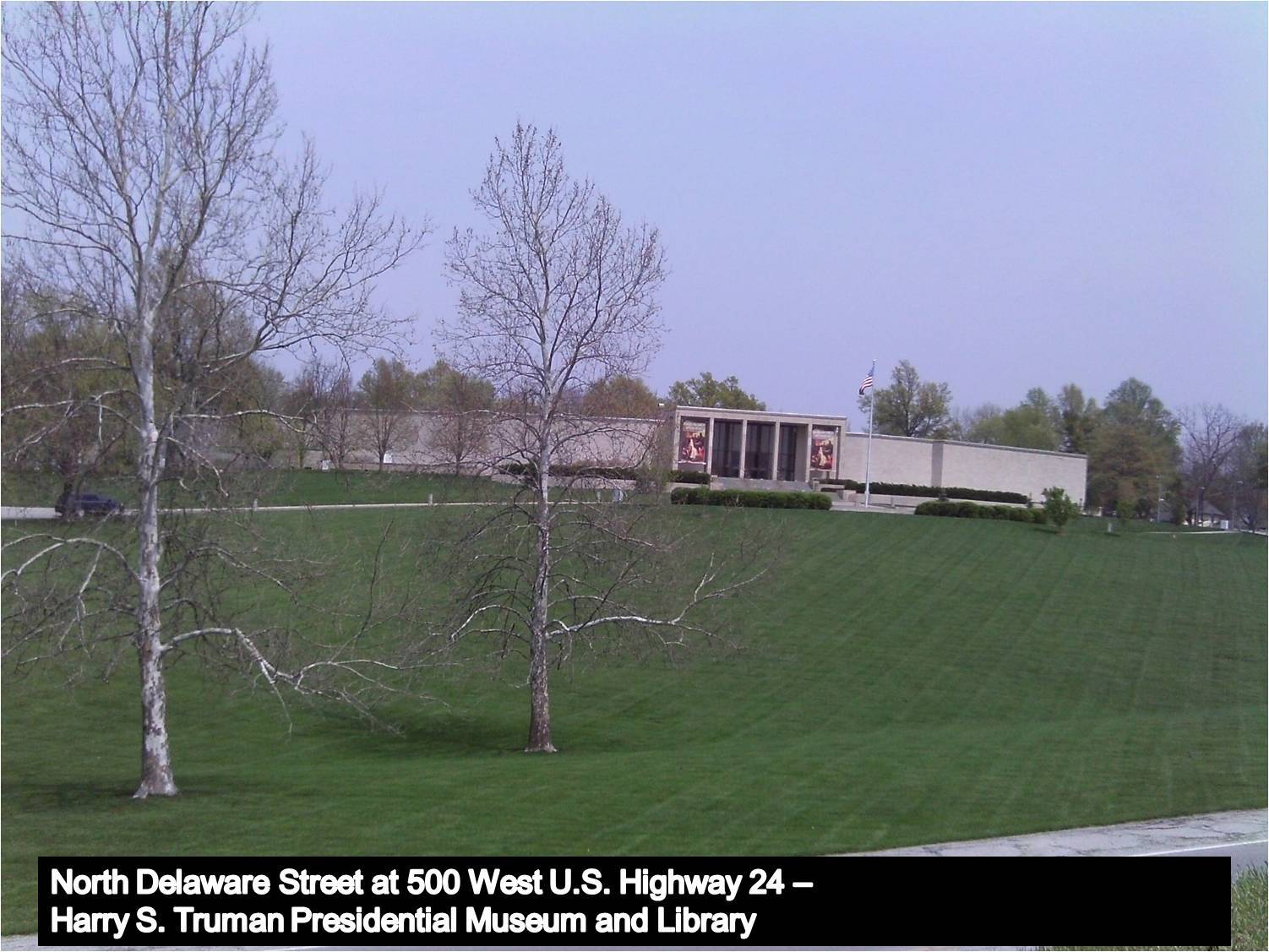
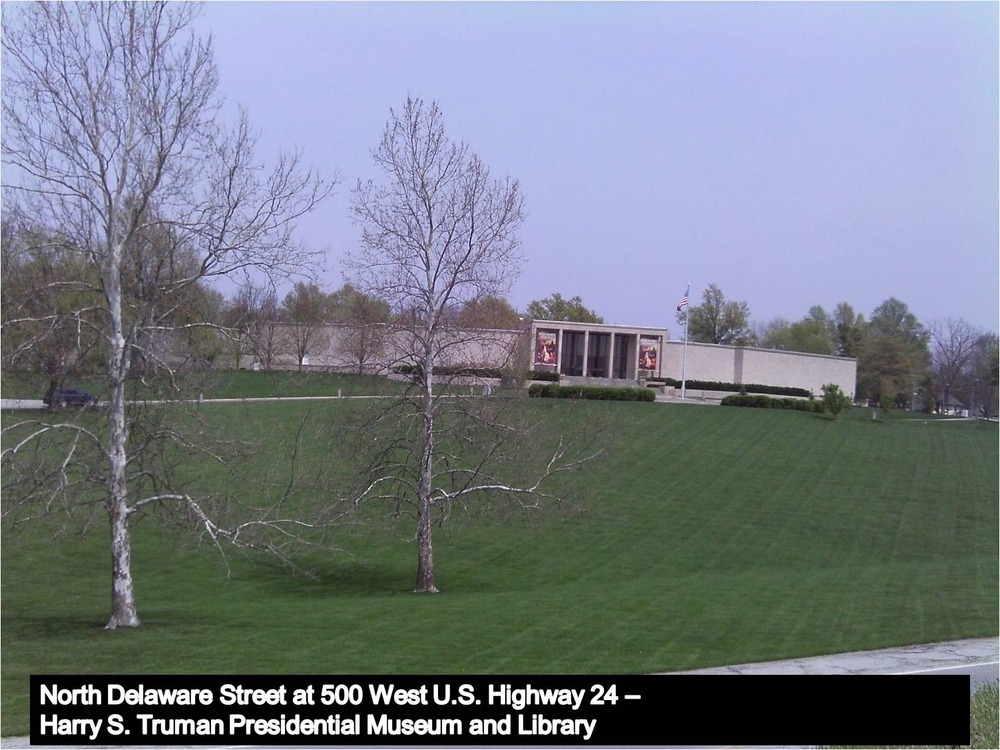
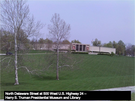
North Delaware Street at 500 West U.S. Highway 24
Image of the Modern-style Harry S. Truman Presidential Museum and Library.
Resource 139
North Delaware Street at 500 West U.S. Highway 24 (in 2011)
Classification: Contributing.
Historic Name: Harry S. Truman Presidential Museum and Library.
Architectural Style: Modern.
Construction Date: 1956-1957 / 1967 / 1979 / 2001.
Period 5 of Harry S Truman's Life: Serving as Elder Statesman, 1953-1971.
Tax Identification: N/A.
Legal Description: Roosevelt Park Addition, blocks 7-10.
Description: One-story masonry library with basement, irregular in shape; sloping roof; buff-colored Indiana limestone exterior, green tone chipped granite, and aluminum; aluminum windows; three tiers of steps lead to columned entrance with burnished aluminum and tinted glass front and green-toned chipped granite portico, on the southwest façade; full basement. Original 70,000 square-foot interior: North wing--Harry Truman's office, private and secretarial offices, large reception room, small kitchen and other accessories; southeast wing--museum; northwest wing--offices of the archivists and the stacks; west central section--auditorium and the reading room. The presidential library is located on a grass-covered knoll in park-like setting; the entrance and a curvilinear driveway lead to the main entrance on the south side of the building.
• Alterations: In May 1967, the General Services Administration awarded a contract to Miller-Stauch Construction Company of Kansas City to construct a one hundred-foot addition to the south wing of the library to be used for office space, storage, and exhibit preparation. The architectural firm, Cooper, Robinson & Carlson, designed the addition, at a cost of $285,000. In 1972, a stone wall was constructed that joined the northern end of the addition to the northern wing of the original library, completely enclosing the courtyard. In 1979, an east wing and an east side parking lot were added. Expansion of the library in 1967 and 1979 increased the facility's total square footage by 30,000 to 100,000 square feet. An extensive renovation of the building and exhibits was completed in 2000-2001. This project included improvements to the interior courtyard and the construction of a small addition in the southeast corner of the courtyard. The addition provides interior space for viewing the Truman gravesites, with large windows looking out onto the courtyard, benches, a surface-installed eternal flame and a statue of Harry Truman. This alteration allows visitors who may not be able to venture out into the courtyard to view the gravesites from this interior area and, in effect, to commemorate the lives of Bess and Harry Truman, and their daughter, Margaret, from this vantage point.
• As mentioned above, the property includes the gravesites of Harry and Bess, and the remains of Margaret Truman Daniel and Margaret's husband, Clifton Daniel, all of which are located in the building's interior courtyard [Resource 140]. These, together, are counted as a contributing site within the Truman Historic District. Harry Truman died the day after Christmas, on December 26, 1972, and was buried here in the courtyard of the library facility. Bess lived for an additional ten years, in the family home on Delaware Street [Resource 042], and died there on October 18, 1982. She was laid to rest here in the courtyard, next to her husband. Margaret Truman Daniel died on January 29, 2008. Her remains and those of her husband, Clifton, who died in 2000, were interred on February 24, 2008, in a vault located near the Truman graves. The courtyard also contains several landscape features, including brick and concrete walkways, low ground-level lighting, planting beds, some lawn area, several small- and medium-size shade trees, and a centrally located flagpole.
History/Significance: The 1971 statement of significance for the Truman district identified the library with the statement that, "On the north the district is bounded by the Truman Library, completed in 1957 to house the Presidential papers." After his retirement, Truman was actively involved in the planning for his presidential library and biographer Robert Ferrell says was "delighted" with the location in Independence near his home. Truman maintained an office there and kept regular hours for most of his remaining years, arriving shortly before 8:00 every weekday morning. In his memoir, Mr. Citizen, Truman recalled, "I used to walk to the Library, a distance of six blocks (from the Truman home), but soon had to stop that because too many people wanted to talk to me along the way and I could not get to my office on time."
The firm of Gentry and Voscamp, Architects, designed the original core of the Harry S. Truman Presidential Museum and Library. Neild and Somdal of Shreveport, Louisiana, created the original design. Henry J. Massman and Salvatore Patti, construction companies, built the library at a cost of $1,750,000. All work performed by these construction companies was billed at cost only; all usual profit and mark-up was donated by the companies. Over 17,000 individuals and organizations donated $1,155,000 to construct the library, as well as purchase the library site, which occupied a portion of the twenty-two-acre Slover Memorial Park. The City of Independence acquired eleven houses that were located on the library site and sold them at auction. Several of the houses were relocated to other neighborhoods in Independence, including one moved to the 500-block of Hocker [outside the historic district]. Six lots were acquired by condemnation proceedings initiated by the Missouri State Highway Department for the construction of a library access right-of-way on the north side of Highway 24. The construction of the library re-shaped a historically black section of Independence, displacing many African American families under the auspices of "urban renewal."
Construction of the library was completed two years after former President Truman broke ground on May 8, 1955 (his 71st birthday). The 70,000 square-foot building was dedicated on July 6, 1957, and represented the culmination of eight years of effort commencing with a City Council resolution enacted in January of 1949 advocating the creation of a presidential library. During the dedication ceremony, former President Harry S Truman conveyed approximately 10,000 books, gifts, and mementos received by him during his presidency. Attendees at the dedication included former President Herbert Hoover, Eleanor Roosevelt, and Chief Justice Earl Warren as well as Democratic and Republican leaders of both legislative houses. After its opening, Harry Truman worked nearly every day at the library, writing speeches and letters, answering letters, meeting guests, making documentary films, giving tours of the building, and speaking to students in the auditorium. He continued working at the library through 1966. Both Harry and Bess Truman were buried in the library courtyard [Resource 140] following their deaths, Harry's in 1972 and Bess's in 1982. The remains of Margaret Truman Daniel and her husband, Clifton, were interred in the courtyard in 2008.
Significantly, the Truman Presidential Museum and Library was the first presidential library to be established following the enabling federal legislation of 1950, which empowered the U.S. government to accept presidential papers, and additional legislation, the Presidential Libraries Act of 1955, that authorized federal ownership and operation of presidential libraries. (Prior to that time, three privately funded presidential libraries had been established: The Hayes Memorial Library in Freemont, Ohio; the Hoover Library at Stanford University; and the Franklin D. Roosevelt Library in Hyde Park, New York.) The statute authorized the General Services Administration to accept a completed building, together with presidential papers, and to maintain and operate presidential libraries. Note: This resource, along with the Courtyard of the Harry S. Truman Presidential Museum and Library [Resource 140], and the Harry S Truman Statue [Resource 176], is unique in the district because it is considered contributing, even though it post-dates the period of significance (which ends in 1971), due to its obvious connection with Harry Truman. Therefore, the resource is considered to be contained within Period 5 of Harry S Truman’s Life – Serving as Elder Statesman. The library underwent another major renovation project in 2019-2020. This renovation moved the main entrance to the east side of the building. –JW
Permission must be secured from the individual copyright owners to reproduce any copyrighted materials contained within this website. Digital assets without any copyright restrictions are public domain.
NPS/Jeff Wade
Public domain:Full Granting Rights
Image
Harry S. Truman National Historic Site, Code: HSTR
North Delaware Street at 500 West U.S. Highway 24, Independence, Harry S. Truman National Historic Site, Jackson County, Missouri
Latitude: 38.9012985229492, Longitude: -94.5307006835938
Latitude: 38.9012985229492, Longitude: -94.5307006835938
05/01/2011 | Date is approximate. All photographs were taken during May 2011.
01/01/0001
Public Can View
Friday, September 17, 2021 9:40:26 AM
Thursday, September 23, 2021 3:31:40 PM
_139 North Delaware Street at 500 West US Highway 24.jpg
Monday, January 1, 0001 12:00:00 AM
jpg
201.3 kB
Scenic