Select Item below to DOWNLOAD - Once item is selected, right click and choose 'save as'


89ba88dd-514f-4cdb-a4a4-0cd8e4ebff7e
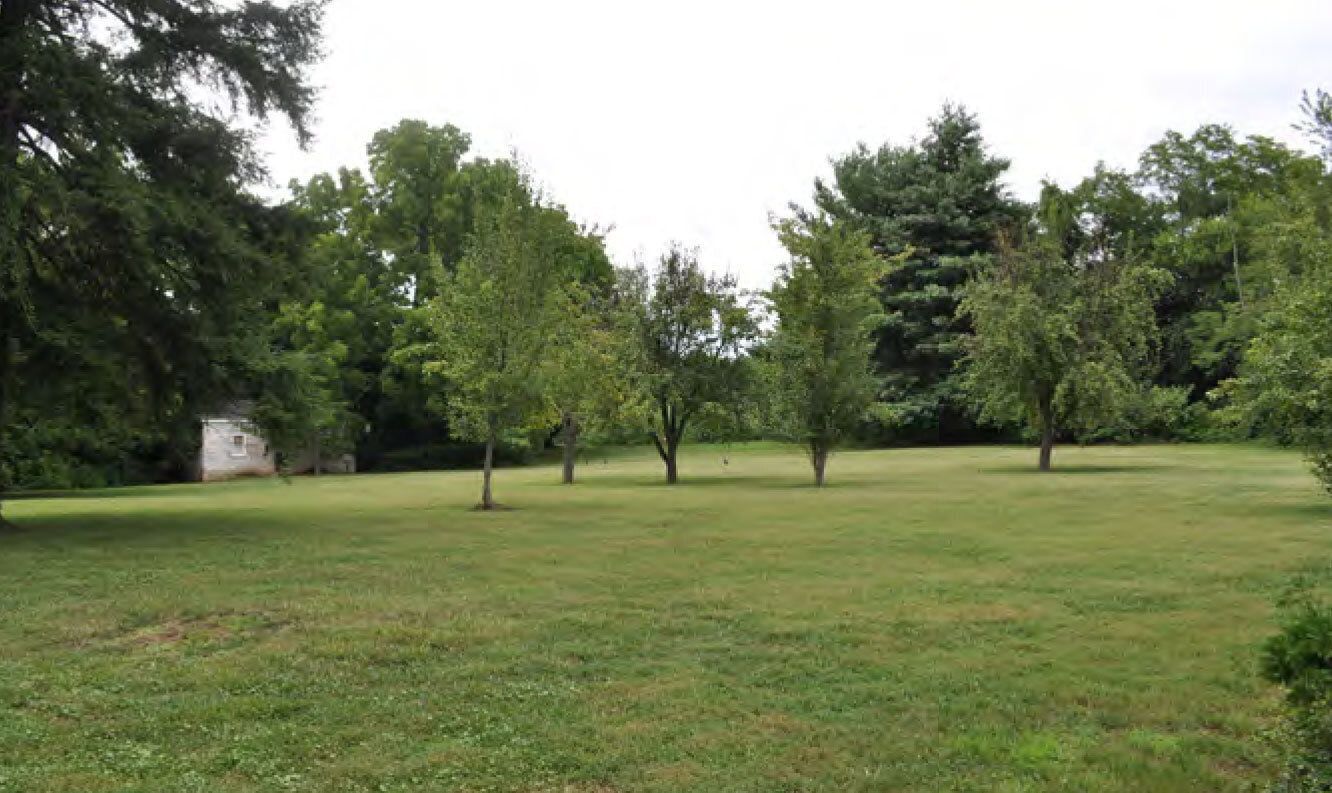
Orchard Trees at Chatham Manor (2014)
A cluster of six pear trees with leafy branches stands on a mown lawn, which is framed by a perimeter of trees and a small structure.
Chatham Manor represents a core landscape of the historically sprawling plantation and elements of the Colonial Revival garden design. Early references to Chatham Manor’s fruit trees date to 1798 and 1799, when William Fitzhugh sent George Washington cherry, pear, and apple trees from Chatham. Orchard trees were likely the primary trees species grown at Chatham during its early years, up until the Civil War. All vegetation in the ravines and on the northeast side of the house was cut down for firewood during the war, and Chatham’s two orchards were also destroyed. The orchards at Chatham were not replaced until the early twentieth century by the Devores, who planted an extensive apple and pear orchard beyond the North Ravine and a smaller orchard (likely pears) in the vicinity of the Milk House that helped shape the organization and use of Chatham’s grounds between 1920 and 1931. By the Devore’s ownership, there was a small orchard of approximately thirty trees planted on an orthogonal grid. Under owners John Lee and Lillian Pratt, from 1931 to 1975, extensive orchards were maintained at Chatham. By John Lee Pratt’s death, the larger orchard was greatly diminished in size, but remained along with the fruit trees near the Milk House. This covering of fruit trees was supplemented with forest trees. Today, the Orchard Area is located between the North Ravine and the Carriage Drive, in the vicinity of the Milk House. It encompasses an area of approximately one acre of trees over lawn, including a notable collection of specimen deciduous tree and six remaining pear trees (of a once larger orchard) in a grid formation. The specimen trees over mown lawn impart the character of a grand country estate, as it was managed by the Devores and Pratts. However, many of the trees in the area are mature and beginning to decline.
The 2019 CLR recommends reestablishing an orchard to the northeast of the Northwest Field, by removing existing vegetation and replacing it with a fruit planting that evokes the historic appearance of the orchard. Although the historic form of fruit trees is not known, many early orchards were standard, or grown on rootstock that allowed each tree to reach its natural height, and pruned into an open bowl form. This form might appropriately be perpetuated in the new orchard through active management and pruning.
U.S. Department of the Interior, National Park Service
Cultural Landscapes
Permission must be secured from the individual copyright owners to reproduce any copyrighted materials contained within this website. Digital assets without any copyright restrictions are public domain.
NPS
Public domain:Full Granting Rights
Image
Fredericksburg and Spotsylvania National Military Park, Code: FRSP
Park Cultural Landscapes Program, Code: PCLP
Park Cultural Landscapes Program, Code: PCLP
Chatham Manor, Fredericksburg and Spotsylvania National Military Park, Virginia
Latitude: 38.2948608398438, Longitude: -77.7218475341797
Latitude: 38.2948608398438, Longitude: -77.7218475341797
Cultural Resources Inventory System-Cultural Landscapes (CRIS-CL) : 300178
Title: Chatham Manor: Cultural Landscape Inventory
URL: https://irma.nps.gov/DataStore/Reference/Profile/2244642
Title: Cultural Landscape Report for Chatham, Fredericksburg and Spotsylvania National Military Park
URL: https://irma.nps.gov/DataStore/Reference/Profile/2271677
URL: https://irma.nps.gov/DataStore/Reference/Profile/2244642
Title: Cultural Landscape Report for Chatham, Fredericksburg and Spotsylvania National Military Park
URL: https://irma.nps.gov/DataStore/Reference/Profile/2271677
2014
2014
Public Can View
Person: Susan Dolan
Organization: Park Cultural Landscapes Program
Position: Program Manager
Email: susan_dolan@nps.gov
Organization: Park Cultural Landscapes Program
Position: Program Manager
Email: susan_dolan@nps.gov
Friday, June 16, 2023 5:25:31 PM
Friday, June 16, 2023 5:56:33 PM
FRSP-Chatham-Manor-orchard-2014.jpg
Monday, January 1, 0001 12:00:00 AM
jpg
190.1 kB
Scenic