Select Item below to DOWNLOAD - Once item is selected, right click and choose 'save as'

6d7bfcae-c268-4e38-9ef2-82f05e8ddab7
Frances (Appleton) Longfellow to Mary (Appleton) Mackintosh, 31 January 1846
Manuscript letter
Craigie House. Jan 31st
1846.
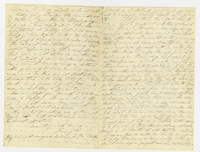
Greatly disappointed were we, dearest darling, not to get the expected news by the last steamer, but it was a joy to know you continued so well up to that time, & were so pleasantly anchored in London town. Long ere this my dear, little, cockney nephew must have announced himself, & Malthus groans in his grave. A thousand blessings on him nevertheless!
What a happy truth it is that commonest & stalest of all possible facts, a birth, is to two people at least as fresh & new as Cain was to Eve, & little do they feel the weight of the generations behind, to which this adds an apparently insignificant grain, but which in time may expand itself over a whole field to form the heavenly harvest. These are thoughts with eagles wings to lift us above the petty, nursery cares, which seem to bind us to the very visible real [p. 2] ities alone. My baby is to me almost a greater joy & mystery than Charlie was, - he seems such a strange repetition of him at times, that I feel as if I were dreaming. The oppressive anxiety & ignorance of management make the first child hardly as enjoyable as the second I think. This one of mine is also remarkably quiet & happy, smiling & cooing deliciously all day long. Charlie has fits of jealousy, but also of love, & wants to hold him & play with him rather roughly, & lay his cheek upon his mount to be kissed. I hope he will be quieter & less impetuous than Charlie, for though it is beautiful to see his untiring energy & overflowing life, yet I should like, for variety, a still boy. Pictures and stories alone keep those restless feet quiet a moment, but for these he has an absorbing passion, and will sit upon my knee until both are exhausted, making eager comments in his unknown tongue, which I long to have interpreted. He will not talk English, though he understands everything we say, & no lover desired a gracious word more fervently than I do any words from his little tongue. His backwardness with his teeth prevents it possibly. [p. 3] He has always reminded me of Ronny in looks & ways, & Mrs Everett, who saw him the other day at Aunt Sally’s, tho’t him very like him only more robust looking. His eyes are growing now more like mine, but the baby’s are very like Henry’s in shape & expression. Sarah Cleveland gave me delightful accounts of your good looks, & I fervently trust, dearest, your strength will not suffer by this new care. There is a comfortable interval happily between your children’s ages; now mine are both babies, &, as Charlie has not half his teeth yet, I have kept the little one at night longer than I should otherwise, that they should not disturb each other. Next week we go into town for some weeks, it being vacation, & then I may make a change if I feel the fatigue too much.
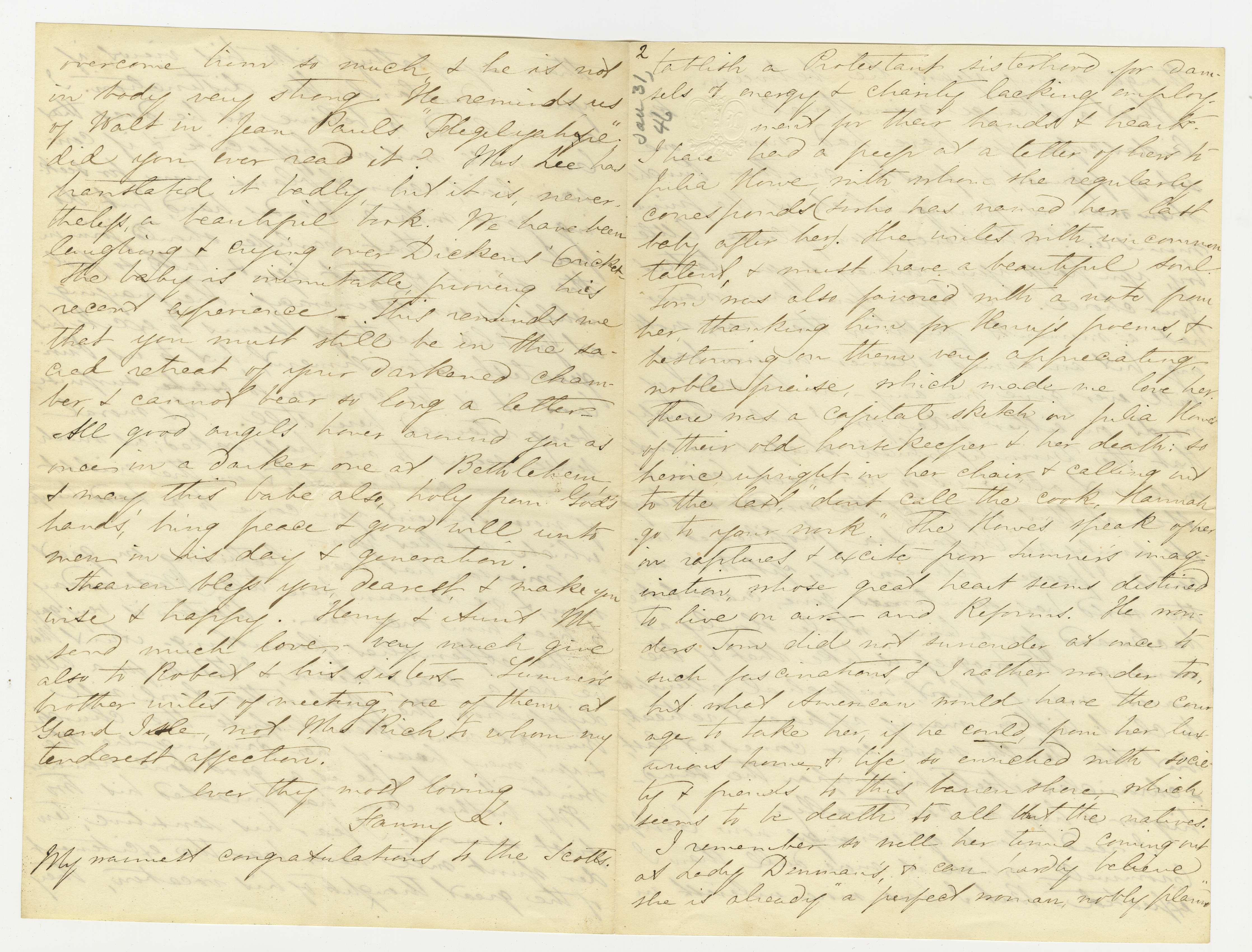
I have been hoping Emmeline would be there during our visit, but alas! her honey-moon has been sadly over clouded, & she is still retained at Geneseo by the severe illness of Wadsworth. He has been suffering much from violent headaches for many months, and just after they reached his home, he struck his head by a fall on the ice, which brought out the latent disease as a congestion of the brain. He was very ill, & they almost despaired of his [p. 4] life, but that terrible sorrow was averted from dear Emmeline, & he is now slowly recovering, how permanently we cannot say. This is a melancholy prelude to her wedded life, but I trust the remainder will be all the brighter. Her wedding was a very brilliant one, & I got to it safely. All her old friends were present but the Prescotts, Mrs Amory’s death preventing them; [crossed out: & much dressed] – The ceremony was very touching, her old father leaning on his cane by her side, & looking serenely happy to lay up his treasure in safe keeping. Elisabeth W. on the other side, her lovely face radiant in sympathy with her brother’s happiness, all the more perhaps that her own was so dimmed. Emmeline looked, unlike herself, rigid as marble, but when it was over, her tears broke the spell, & she thawed into her usual joyfulness. The excitement happily did me no injury, - & now it is decided irrevocably I have forgotten, as I trust you have, all my misgivings. Em takes great delight in her new sister, as well she may. I fell in love with her afresh, & wish much she would have remained here longer. She says she was made for a sister of Charity. She has shown in Wms illness such firmness & gentleness, & capacities as a nurse. That reminds me of Florence Nightengale’s desire to es- [p. 5] tablish a Protestant sisterhood for damsels of energy & charity lacking employment for their hands & hearts. I have had a peep at a letter of her’s to Julia Howe, with whom she regularly corresponds (& who has named her last baby after her). She writes with uncommon talent, & must have a beautiful soul. Tom was also favored with a note from her, thanking him for Henry’s poems, & bestowing on them very appreciating, noble praise, which made me love her. There was a capital sketch in Julia Howe’s of their old housekeeper & her death: so heroic, upright in her chair, & calling out to the last, “dont call the cook, Hannah go to your work.” The Howes speak of her in raptures & excite poor Sumner's imagination, whose great heart seems destined to live on air – and Reforms. He wonders Tom did not surrender at once to such fascinations, & I rather wonder too, but what American would have the courage to take her, if he could, from her luxurious home & life so enriched with society & friends to this barren shore, which seems to be death to all but the natives.
I remember so well her timid coming-out at Lady Denman’s, & can hardly believe she is already “a perfect woman, nobly plannd” [p. 6] though many years lie between.
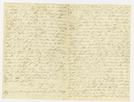
What a strange ministerial kaleidoscope you have had, - now one set of figures, & presto – another. Punch’s showman is funny – “which is the prime minister”? “whichever you please, little boy, you pays your money, & you takes your choice.” I hope you have never had a moments’ faith in the war, nothing but an armed steamer in our bay will ever give me any – no bluster of words on either side, for I feel strongly that “the Divinity which shapes our end”s will not allow us to re-enact Cain & Abel at this stage of the world’s history. As firmly as Cassandra prophecied war, could I peace between us-, yet, to be sure, the world has sometimes gone, crab-like, backward for a time while slowly advancing – many short, ineffectual attempts to climb higher, many apparent retreats, but the tenth wave ever comes at last, & chronicles itself high upon the sand – higher & higher continually.
I read aloud of evenings now Carlyle’s Cromwell, which is more dull than I expected. But I have more interest in [p. 7] than sympathy with his views, if you understand the distinction. I am inclined to believe, as he does, that Cromwell was no hypocrite, &, if conscientious, cannot blame him for seeking good with a bloody hand, but do feel sorrow that Carlyle should join in the spirit of that age & talk so foolishly of our degeneracy. The praying at public meetings seems to excite his greatest astonishment, but to us Puritans it is too common to excite surprise, being retained here still. His moral sense seems to me half-baked; as much so as our civilization, & in the midst of nourishment you come to a hard lump which chokes you.
Emerson has been lecturing on great men, & we remain here till Wednesday to hear him once here. Boston is very gay, & the Assemblies flourishing. Aunt Mattie had a secret desire, I think, for a little dissipation, the flesh & the devil will triumph now & then despite the church, & you may hear of her dancing ere the winter is out. She is a good soul however.
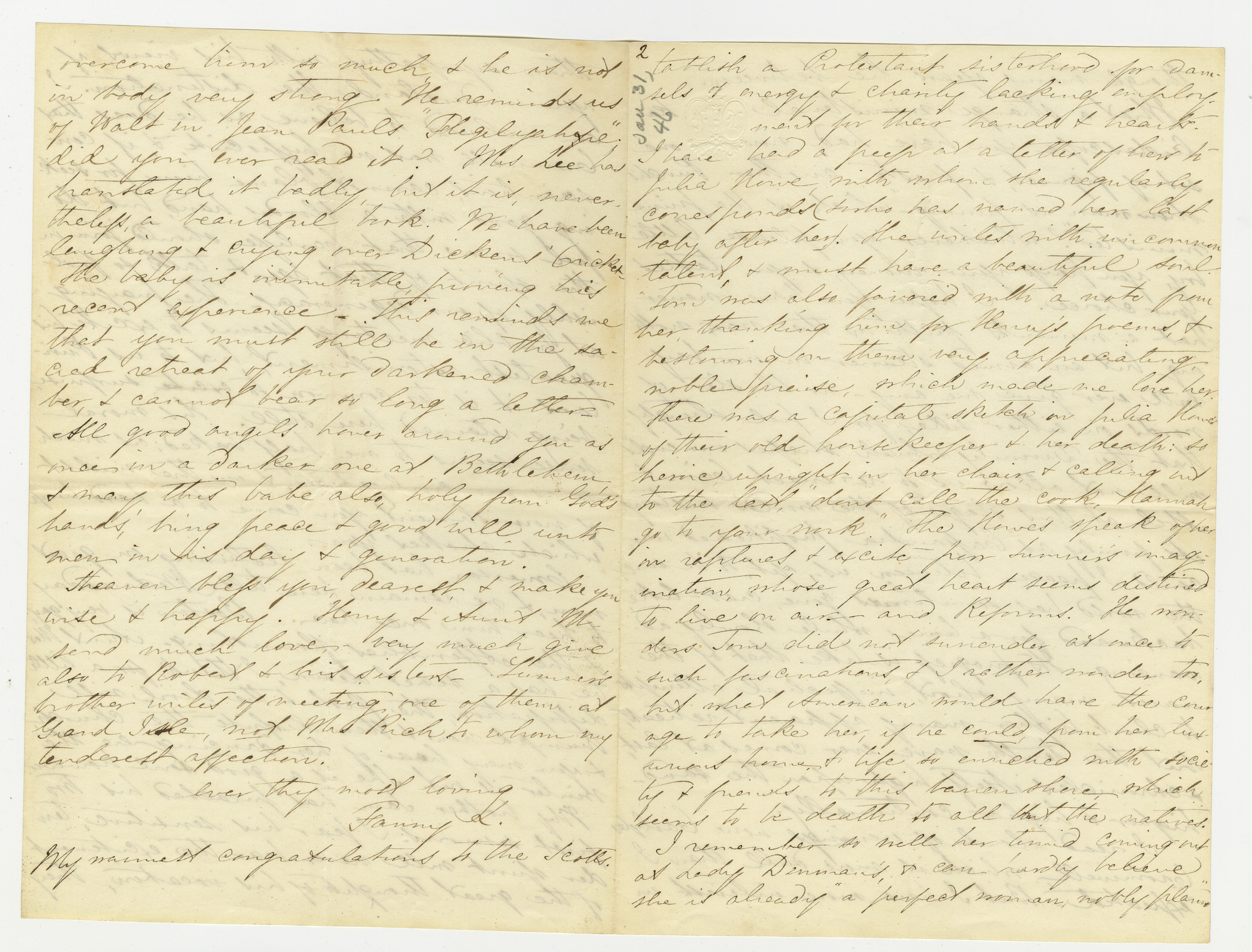
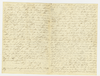
My brother Sam has preached his two first sermons. I fear his sensitive, tender spirit will never bear the excitement of the great thoughts of his vocation, they [p. 8] overcome him so much, & he is not in body very strong. He reminds us of Walt in Jean Pauls “Flegeljah[crossed out: y]re”. did you ever read it? Mrs Lee has translated it badly, but it is, nevertheless, a beautiful book. We have been laughing & crying over Dickens’ Cricket – The baby is inimitable, proving his recent experience. This reminds me that you must still be in the sacred retreat of your darkened chamber, & cannot bear of so long a letter – All good angels hover around you as one in a darker one at Bethlehem, & may this babe also, holy from God’s hands,’ bring peace & good will unto men in his day & generation.
Heaven bless you, dearest, & make you wise & happy. Henry & Aunt M- send much love, - very much give also to Robert & his sisters – Sumner’s brother writes of meeting one of them at Grand Isle, not Mrs Rich to whom my tenderest affection.
ever thy most loving
Fanny L.
My warmest congratulations to the Scotts.
[p. 1 cross] Lowell, the poet, has a girl, Blanche Lowell, from the last day of the year.
I have many fears this will never reach your you wrote the number of your lodgings so indistinctly. Pray give it clearer next time.
1846.
Greatly disappointed were we, dearest darling, not to get the expected news by the last steamer, but it was a joy to know you continued so well up to that time, & were so pleasantly anchored in London town. Long ere this my dear, little, cockney nephew must have announced himself, & Malthus groans in his grave. A thousand blessings on him nevertheless!
What a happy truth it is that commonest & stalest of all possible facts, a birth, is to two people at least as fresh & new as Cain was to Eve, & little do they feel the weight of the generations behind, to which this adds an apparently insignificant grain, but which in time may expand itself over a whole field to form the heavenly harvest. These are thoughts with eagles wings to lift us above the petty, nursery cares, which seem to bind us to the very visible real [p. 2] ities alone. My baby is to me almost a greater joy & mystery than Charlie was, - he seems such a strange repetition of him at times, that I feel as if I were dreaming. The oppressive anxiety & ignorance of management make the first child hardly as enjoyable as the second I think. This one of mine is also remarkably quiet & happy, smiling & cooing deliciously all day long. Charlie has fits of jealousy, but also of love, & wants to hold him & play with him rather roughly, & lay his cheek upon his mount to be kissed. I hope he will be quieter & less impetuous than Charlie, for though it is beautiful to see his untiring energy & overflowing life, yet I should like, for variety, a still boy. Pictures and stories alone keep those restless feet quiet a moment, but for these he has an absorbing passion, and will sit upon my knee until both are exhausted, making eager comments in his unknown tongue, which I long to have interpreted. He will not talk English, though he understands everything we say, & no lover desired a gracious word more fervently than I do any words from his little tongue. His backwardness with his teeth prevents it possibly. [p. 3] He has always reminded me of Ronny in looks & ways, & Mrs Everett, who saw him the other day at Aunt Sally’s, tho’t him very like him only more robust looking. His eyes are growing now more like mine, but the baby’s are very like Henry’s in shape & expression. Sarah Cleveland gave me delightful accounts of your good looks, & I fervently trust, dearest, your strength will not suffer by this new care. There is a comfortable interval happily between your children’s ages; now mine are both babies, &, as Charlie has not half his teeth yet, I have kept the little one at night longer than I should otherwise, that they should not disturb each other. Next week we go into town for some weeks, it being vacation, & then I may make a change if I feel the fatigue too much.
I have been hoping Emmeline would be there during our visit, but alas! her honey-moon has been sadly over clouded, & she is still retained at Geneseo by the severe illness of Wadsworth. He has been suffering much from violent headaches for many months, and just after they reached his home, he struck his head by a fall on the ice, which brought out the latent disease as a congestion of the brain. He was very ill, & they almost despaired of his [p. 4] life, but that terrible sorrow was averted from dear Emmeline, & he is now slowly recovering, how permanently we cannot say. This is a melancholy prelude to her wedded life, but I trust the remainder will be all the brighter. Her wedding was a very brilliant one, & I got to it safely. All her old friends were present but the Prescotts, Mrs Amory’s death preventing them; [crossed out: & much dressed] – The ceremony was very touching, her old father leaning on his cane by her side, & looking serenely happy to lay up his treasure in safe keeping. Elisabeth W. on the other side, her lovely face radiant in sympathy with her brother’s happiness, all the more perhaps that her own was so dimmed. Emmeline looked, unlike herself, rigid as marble, but when it was over, her tears broke the spell, & she thawed into her usual joyfulness. The excitement happily did me no injury, - & now it is decided irrevocably I have forgotten, as I trust you have, all my misgivings. Em takes great delight in her new sister, as well she may. I fell in love with her afresh, & wish much she would have remained here longer. She says she was made for a sister of Charity. She has shown in Wms illness such firmness & gentleness, & capacities as a nurse. That reminds me of Florence Nightengale’s desire to es- [p. 5] tablish a Protestant sisterhood for damsels of energy & charity lacking employment for their hands & hearts. I have had a peep at a letter of her’s to Julia Howe, with whom she regularly corresponds (& who has named her last baby after her). She writes with uncommon talent, & must have a beautiful soul. Tom was also favored with a note from her, thanking him for Henry’s poems, & bestowing on them very appreciating, noble praise, which made me love her. There was a capital sketch in Julia Howe’s of their old housekeeper & her death: so heroic, upright in her chair, & calling out to the last, “dont call the cook, Hannah go to your work.” The Howes speak of her in raptures & excite poor Sumner's imagination, whose great heart seems destined to live on air – and Reforms. He wonders Tom did not surrender at once to such fascinations, & I rather wonder too, but what American would have the courage to take her, if he could, from her luxurious home & life so enriched with society & friends to this barren shore, which seems to be death to all but the natives.
I remember so well her timid coming-out at Lady Denman’s, & can hardly believe she is already “a perfect woman, nobly plannd” [p. 6] though many years lie between.
What a strange ministerial kaleidoscope you have had, - now one set of figures, & presto – another. Punch’s showman is funny – “which is the prime minister”? “whichever you please, little boy, you pays your money, & you takes your choice.” I hope you have never had a moments’ faith in the war, nothing but an armed steamer in our bay will ever give me any – no bluster of words on either side, for I feel strongly that “the Divinity which shapes our end”s will not allow us to re-enact Cain & Abel at this stage of the world’s history. As firmly as Cassandra prophecied war, could I peace between us-, yet, to be sure, the world has sometimes gone, crab-like, backward for a time while slowly advancing – many short, ineffectual attempts to climb higher, many apparent retreats, but the tenth wave ever comes at last, & chronicles itself high upon the sand – higher & higher continually.
I read aloud of evenings now Carlyle’s Cromwell, which is more dull than I expected. But I have more interest in [p. 7] than sympathy with his views, if you understand the distinction. I am inclined to believe, as he does, that Cromwell was no hypocrite, &, if conscientious, cannot blame him for seeking good with a bloody hand, but do feel sorrow that Carlyle should join in the spirit of that age & talk so foolishly of our degeneracy. The praying at public meetings seems to excite his greatest astonishment, but to us Puritans it is too common to excite surprise, being retained here still. His moral sense seems to me half-baked; as much so as our civilization, & in the midst of nourishment you come to a hard lump which chokes you.
Emerson has been lecturing on great men, & we remain here till Wednesday to hear him once here. Boston is very gay, & the Assemblies flourishing. Aunt Mattie had a secret desire, I think, for a little dissipation, the flesh & the devil will triumph now & then despite the church, & you may hear of her dancing ere the winter is out. She is a good soul however.
My brother Sam has preached his two first sermons. I fear his sensitive, tender spirit will never bear the excitement of the great thoughts of his vocation, they [p. 8] overcome him so much, & he is not in body very strong. He reminds us of Walt in Jean Pauls “Flegeljah[crossed out: y]re”. did you ever read it? Mrs Lee has translated it badly, but it is, nevertheless, a beautiful book. We have been laughing & crying over Dickens’ Cricket – The baby is inimitable, proving his recent experience. This reminds me that you must still be in the sacred retreat of your darkened chamber, & cannot bear of so long a letter – All good angels hover around you as one in a darker one at Bethlehem, & may this babe also, holy from God’s hands,’ bring peace & good will unto men in his day & generation.
Heaven bless you, dearest, & make you wise & happy. Henry & Aunt M- send much love, - very much give also to Robert & his sisters – Sumner’s brother writes of meeting one of them at Grand Isle, not Mrs Rich to whom my tenderest affection.
ever thy most loving
Fanny L.
My warmest congratulations to the Scotts.
[p. 1 cross] Lowell, the poet, has a girl, Blanche Lowell, from the last day of the year.
I have many fears this will never reach your you wrote the number of your lodgings so indistinctly. Pray give it clearer next time.
Archives Number: 1011/002.001-016#003
U. S. National Park Service
Permission must be secured from the individual copyright owners to reproduce any copyrighted materials contained within this website.
Courtesy of National Park Service, Longfellow House-Washington's Headquarters of National Historic Site
Public domain
Correspondence (1011/002), (LONG-SeriesName)
, Letters from Frances Longfellow (1011/002.001), (LONG-SubseriesName)
, 1846 (1011/002.001-016), (LONG-FileUnitName)
, Letters from Frances Longfellow (1011/002.001), (LONG-SubseriesName)
, 1846 (1011/002.001-016), (LONG-FileUnitName)
Image
Longfellow House - Washington's Headquarters National Historic Site, Code: LONG
Longfellow House - Washington's Headquarters National Historic Site, Middlesex County, Massachusetts
Latitude: 42.3769989013672, Longitude: -71.1264038085938
Latitude: 42.3769989013672, Longitude: -71.1264038085938
NPS Museum Number Catalog : LONG 20257
Title: Finding Aid to the Frances Elizabeth Appleton Longfellow (1817-1861) Papers, 1825-1961 (bulk dated: 1832-1861)
URL: https://www.nps.gov/long/learn/historyculture/archives.htm#FEAL
URL: https://www.nps.gov/long/learn/historyculture/archives.htm#FEAL
2016-08-08
01/31/1846
Manuscript letter in Frances Appleton Longfellow Papers, Series II. Correspondence, A. Outgoing, 1846. (1011/002.001-016#003)
Public Can View
Organization: Longfellow House-Washington's Headquarters National Historic Site
Address: 105 Brattle Street, Cambridge, MA 02138
Email: LONG_archives@nps.gov
Address: 105 Brattle Street, Cambridge, MA 02138
Email: LONG_archives@nps.gov
Wednesday, November 9, 2022 6:24:47 PM
Wednesday, November 9, 2022 6:24:47 PM
1011-02-01-16-03 p5+8.jpg
jpg
16.8 MB
Historic