Select Item below to DOWNLOAD - Once item is selected, right click and choose 'save as'



6605f64b-267c-475a-a140-872cc898e995
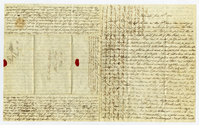
Frances (Appleton) Longfellow to Nathan Appleton, 30 June 1841
Manuscript letter
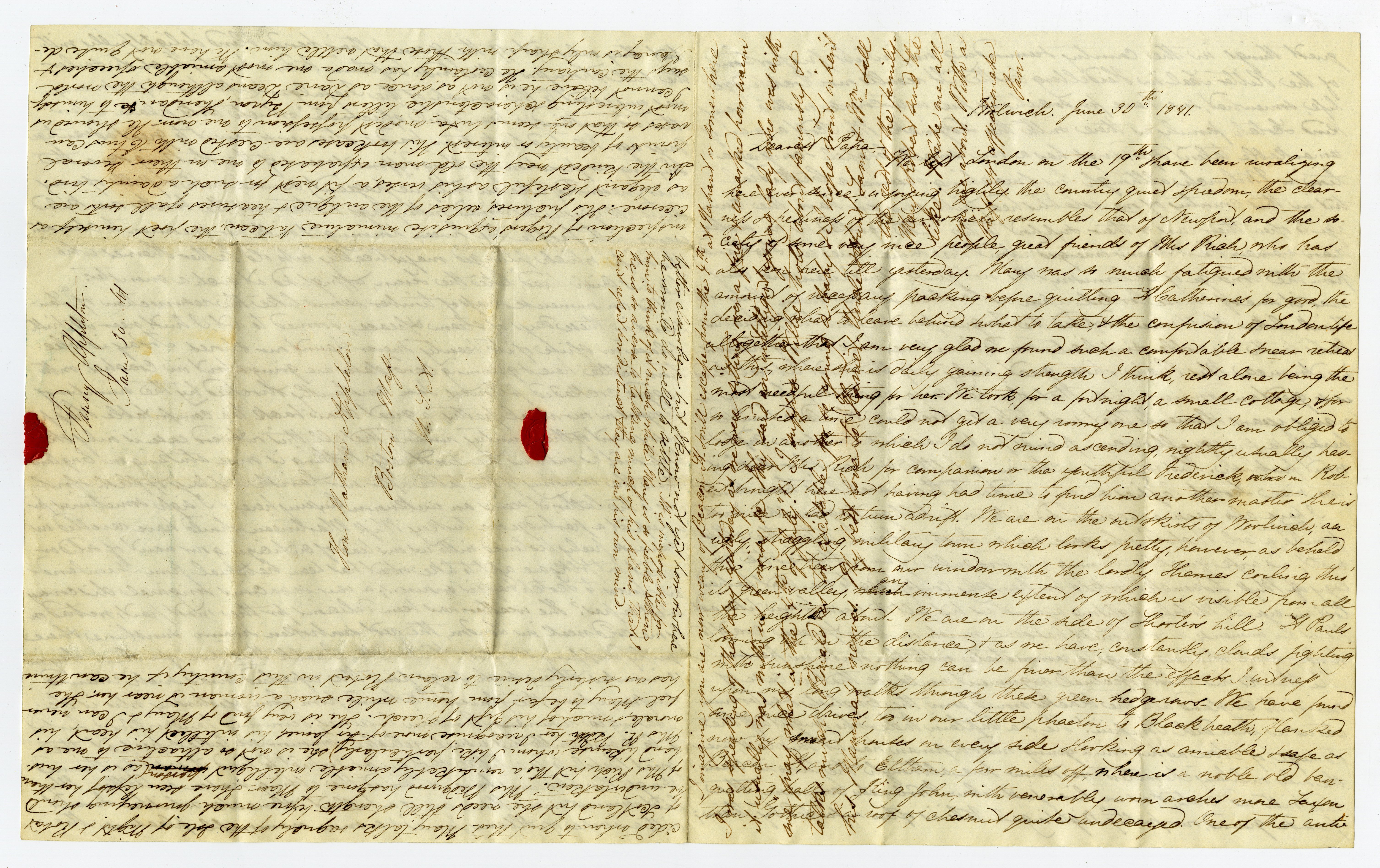
Woolwich. June 30th 1841.
Dearest Papa,
We left London on the 19th & have been ruralizing here ever since, enjoying highly the country quiet & freedom, the clearness & freshness of the air, which resembles that of Newport, and the society of some very nice people, great friends of Mrs Rich, who has also been here till yesterday. Mary was so much fatigued with the amount of necessary packing before quitting St Catherine’s for good, the deciding what to leave behind & what to take, & the confusion of London life altogether that I am very glad we found such a comfortable & near retreat as this, where she is daily gaining strength I think, rest alone being the most needful thing for her. We took, for a fortnight, a small cottage, & for so limited a time, could not get a very roomy one so that I am obliged to lodge in another to which I do not mind ascending, nightly usually having dear Mrs Rich for companion or the youthful Frederick, whom Robert brought here not having had time to find him another master & he is too nice a lad to turn adrift. We are on the outskirts of Woolwich, an ugly, straggling, military town which looks pretty, however, as beheld thro’ fine trees from our window with the lordly Thames coiling thro’ its green valley [crossed out: which] an immense extent of which is visible from all the heights about – We are on the side of Shooter’s hill. St Pauls looming up in the distance, & as we have, constantly, clouds fighting with sunshine nothing can be finer than the effects I witness upon my long walks through these green hedgerows. We have found some nice drives, too, in our little phaeton to Blackheath, flanked now by smart houses on every side & looking as amiable & safe as Beacon St, and to Eltham, a few miles off, where is a noble old banqueting hall of King John, with venerably worn arches more Saxon than Gothic & a roof of chesnut [sic] quite un decayed. One of the anti [p. 2] quest things in the country & reminding me, in its proportions, of the Rutter Saal in Heidelberg Castle. It recalls our Stockbridge life, somewhat, & we have, for society, as free intercourse with a very kind Scotch family as there with the Sedgwicks. Mr Scott, a man of remarkable talent & goodness, has a very small Chapel & congregation in Woolwich, although his preaching deserves a Cathedral, but in this country of one established faith very few have the courage to open their ears or their support to the truth backed by no sectarian name. He & Irving emerged about the same time in Scotland from the bondage of Calvinism, &, tho’ not quite Unitarian, are very near it & are of course looked upon as heretics. I do not mean they both think alike. Scott never adopted the Tongue fanaticism but preaches God’s truth in noble simplicity & would, I am sure, have many hearers in America. Mrs Rich, whose great piety is of the most liberal kind, is so great an admirer of him that she has come here every Sunday for many years & laments that such talent & doctrine should be limited to herself & a few equally warm friends, for he has an extempore gift & wont publish. His wife is a charming little woman & her sisters, two nice Scotch lassies, are my guides to the ruralities herabouts.
I have also become acquainted with an intelligent, agreeable Irish family – that of a a [sic] Col Nichols’ – who gave me an Irish welcome to tea the other night, his wife quickly winning my good will by an enthusiastic eulogy of Miss Sedgwick’s books & he frankly confessed to me that he had lost an eye at Mobile fighiting against us but felt it was a Cain-like act. He is an immense abolitionist, has done much on the African coast to hinder slave-stealing & longs to remonstrate with the South in person! He thinks his most effectual argument would be that in case of war with England all the blacks would join the English & exterminate us as lava did Pompeii! He, a Captain Fade who fought at the old siege of Acre as his son a young midshipman has at this last, are the only military characters we know here, although the town is crammed with red-coats, &, as we live just below Woolwich Common, the parade ground, our pretty “Nightingale Vale” is often infested by them; [p. 3] but they only set off the green & their bands blend delightfully with the full chorusses [sic] of the birds. Captain Fade, a hearty English sailor, was my escort to the launch of the Trafalgar (with his wife & many other womenkind) a beautiful ‘spectacle’ which took place a few days ago. We had tickets on board a steamer so saw it to great advantage, shifting our position & getting different views of the striking scene the river presented (like an antique pageant) crowded with vessells [sic] of every kind, all gayly [sic] festooned with flags & streamers, the banks one kaleidoscope with people, the Queen honoring it with her presence to christen the ship, which plunged majestically into old Father Thames who “hid his crisp head,” like the Severn, affrighted at such a monster. It is an immense mass of timber & seems like the resurrection of a Saurians in these days of steam & peace, doomed to rot, I trust, near its birth place in spite of its beauty & never haunt our shores. Today is Election battle here, & grinning candidates are going about in coaches. with ragged, cockaded followers. I am constantly shocked by the number of beggars in our rural paths, - a great draw-back to a comfortable & happy enjoyment of the country, hinting that all this outward ease is only skin-deep & not, as with us, the worst half. Nothing is more striking in England than the economy of the table after our lavish displays of flesh & fowl. As to the latter, it seems an unknown luxury here, & I sigh sometimes for a peep at a partridge or a turkey. Miss Martineau should have revelled [sic] in game so freely bestowed with us instead of criticizing our want of solider meat but folks are apt to like what has been habitual fro m Greenland’s oil-lovers to Scotch haggis endurers; a very sagacious & original discovery n’est ce pas? The weather has been delicious for the most part; we had only one cold week in London, the rest unbroken & warm sunshine & here gently dropping showers, April-like, I walk thro’ sure of a clear day in 10 minutes - & then such songs from the refreshed birds, such renewed perfume from the flowers! We heard from Tom, yesterday, who is delighting to resume[crossed out: ing] Parisian luxuries – devouring Vaudevilles & Turbos à la crème with his usual relish. Tomorrow we take a peep at the great Babel to do a little shopping & I expect to find it visibly thinned though the Elections have retained the ebbing season a little. My last reminiscences there are of a ball at Almanacks whither I went with a troupe of Albany James’ & a more memorable pleasure the [p. 4 bottom] inspection of Rogers’ exquisite miniature Vatican, the poet himself as cicerone. His pictures, relics of the antique & treasures of all sorts are as elegant & tasteful as his verses, a fit nest for such a dainty bird. In the kindest way the old man expatiated to me on their several points of beauty or interest. His bookcases are crested with Etruscan vases so that one seems but a modest possession to me now. He showed us most interesting & characteristic letters from Byron, Sheridan &c to himself I cannot believe he is not as, douce as Davie Deans although the world says the contrary. He certainly has made me most amiable speeches & I fancy is only sharp with those that nettle him. We have not quite de- [p. 4 top] cided when to quit this – Mary talks vaguely of the Isle of Wight & Robert of Scotland but she needs still strength before much journeying should be undertaken. Mrs Wedgwood has gone to Maer – I have seen less of her than of Mrs Rich but tho’ a remarkably amiable intelligent [crossed out: woman] person (as is her husband likewise whom I like particularly) she is not so attractive to me as Mrs R With her I recognise more of Sir James, his intellect, his heart, his morale, & much of his gift of speech. She is very fond of Mary & I can never feel Mary to be far from home while such a woman is near her. She has no sisterly desire to retain Robert in this country if he can thrive [p. 4 cross] better elsewhere but I know not yet how & where he would do well to settle. It is impossible for him to think of it much while Mary is so feeble & then he is so averse to talking much of his plans that I ca’nt report how distinct they are in his own mind.
[p. 1 cross] I imagine you are now weary of Beacon St. & will escape from the 4th at Nahant or somewhere I was speaking of that day yesterday as we were sitting over a fire & remarked how warm it usually was with us & noisy &c Why said an intelligent young lady who was with me “pray what is the 4th of July”! I suppose Willy trots about famously & talks much. Ronald is too excitable for so young a baby & I hope wont inherit his Mamma’s nerves. My best love to Harriet, Uncle & Aunt Sam & Wm - & all the rest of the family – Mary & Robert send the like. Write me all you are about. With a kiss yr affectionate
Fan.
ADDRESSED: HON NATHAN APPLETON. / BOSTON MASS. / U.S.A.
ENDORSED: FANNY APPLETON. / JUNE 30. 41
Dearest Papa,
We left London on the 19th & have been ruralizing here ever since, enjoying highly the country quiet & freedom, the clearness & freshness of the air, which resembles that of Newport, and the society of some very nice people, great friends of Mrs Rich, who has also been here till yesterday. Mary was so much fatigued with the amount of necessary packing before quitting St Catherine’s for good, the deciding what to leave behind & what to take, & the confusion of London life altogether that I am very glad we found such a comfortable & near retreat as this, where she is daily gaining strength I think, rest alone being the most needful thing for her. We took, for a fortnight, a small cottage, & for so limited a time, could not get a very roomy one so that I am obliged to lodge in another to which I do not mind ascending, nightly usually having dear Mrs Rich for companion or the youthful Frederick, whom Robert brought here not having had time to find him another master & he is too nice a lad to turn adrift. We are on the outskirts of Woolwich, an ugly, straggling, military town which looks pretty, however, as beheld thro’ fine trees from our window with the lordly Thames coiling thro’ its green valley [crossed out: which] an immense extent of which is visible from all the heights about – We are on the side of Shooter’s hill. St Pauls looming up in the distance, & as we have, constantly, clouds fighting with sunshine nothing can be finer than the effects I witness upon my long walks through these green hedgerows. We have found some nice drives, too, in our little phaeton to Blackheath, flanked now by smart houses on every side & looking as amiable & safe as Beacon St, and to Eltham, a few miles off, where is a noble old banqueting hall of King John, with venerably worn arches more Saxon than Gothic & a roof of chesnut [sic] quite un decayed. One of the anti [p. 2] quest things in the country & reminding me, in its proportions, of the Rutter Saal in Heidelberg Castle. It recalls our Stockbridge life, somewhat, & we have, for society, as free intercourse with a very kind Scotch family as there with the Sedgwicks. Mr Scott, a man of remarkable talent & goodness, has a very small Chapel & congregation in Woolwich, although his preaching deserves a Cathedral, but in this country of one established faith very few have the courage to open their ears or their support to the truth backed by no sectarian name. He & Irving emerged about the same time in Scotland from the bondage of Calvinism, &, tho’ not quite Unitarian, are very near it & are of course looked upon as heretics. I do not mean they both think alike. Scott never adopted the Tongue fanaticism but preaches God’s truth in noble simplicity & would, I am sure, have many hearers in America. Mrs Rich, whose great piety is of the most liberal kind, is so great an admirer of him that she has come here every Sunday for many years & laments that such talent & doctrine should be limited to herself & a few equally warm friends, for he has an extempore gift & wont publish. His wife is a charming little woman & her sisters, two nice Scotch lassies, are my guides to the ruralities herabouts.
I have also become acquainted with an intelligent, agreeable Irish family – that of a a [sic] Col Nichols’ – who gave me an Irish welcome to tea the other night, his wife quickly winning my good will by an enthusiastic eulogy of Miss Sedgwick’s books & he frankly confessed to me that he had lost an eye at Mobile fighiting against us but felt it was a Cain-like act. He is an immense abolitionist, has done much on the African coast to hinder slave-stealing & longs to remonstrate with the South in person! He thinks his most effectual argument would be that in case of war with England all the blacks would join the English & exterminate us as lava did Pompeii! He, a Captain Fade who fought at the old siege of Acre as his son a young midshipman has at this last, are the only military characters we know here, although the town is crammed with red-coats, &, as we live just below Woolwich Common, the parade ground, our pretty “Nightingale Vale” is often infested by them; [p. 3] but they only set off the green & their bands blend delightfully with the full chorusses [sic] of the birds. Captain Fade, a hearty English sailor, was my escort to the launch of the Trafalgar (with his wife & many other womenkind) a beautiful ‘spectacle’ which took place a few days ago. We had tickets on board a steamer so saw it to great advantage, shifting our position & getting different views of the striking scene the river presented (like an antique pageant) crowded with vessells [sic] of every kind, all gayly [sic] festooned with flags & streamers, the banks one kaleidoscope with people, the Queen honoring it with her presence to christen the ship, which plunged majestically into old Father Thames who “hid his crisp head,” like the Severn, affrighted at such a monster. It is an immense mass of timber & seems like the resurrection of a Saurians in these days of steam & peace, doomed to rot, I trust, near its birth place in spite of its beauty & never haunt our shores. Today is Election battle here, & grinning candidates are going about in coaches. with ragged, cockaded followers. I am constantly shocked by the number of beggars in our rural paths, - a great draw-back to a comfortable & happy enjoyment of the country, hinting that all this outward ease is only skin-deep & not, as with us, the worst half. Nothing is more striking in England than the economy of the table after our lavish displays of flesh & fowl. As to the latter, it seems an unknown luxury here, & I sigh sometimes for a peep at a partridge or a turkey. Miss Martineau should have revelled [sic] in game so freely bestowed with us instead of criticizing our want of solider meat but folks are apt to like what has been habitual fro m Greenland’s oil-lovers to Scotch haggis endurers; a very sagacious & original discovery n’est ce pas? The weather has been delicious for the most part; we had only one cold week in London, the rest unbroken & warm sunshine & here gently dropping showers, April-like, I walk thro’ sure of a clear day in 10 minutes - & then such songs from the refreshed birds, such renewed perfume from the flowers! We heard from Tom, yesterday, who is delighting to resume[crossed out: ing] Parisian luxuries – devouring Vaudevilles & Turbos à la crème with his usual relish. Tomorrow we take a peep at the great Babel to do a little shopping & I expect to find it visibly thinned though the Elections have retained the ebbing season a little. My last reminiscences there are of a ball at Almanacks whither I went with a troupe of Albany James’ & a more memorable pleasure the [p. 4 bottom] inspection of Rogers’ exquisite miniature Vatican, the poet himself as cicerone. His pictures, relics of the antique & treasures of all sorts are as elegant & tasteful as his verses, a fit nest for such a dainty bird. In the kindest way the old man expatiated to me on their several points of beauty or interest. His bookcases are crested with Etruscan vases so that one seems but a modest possession to me now. He showed us most interesting & characteristic letters from Byron, Sheridan &c to himself I cannot believe he is not as, douce as Davie Deans although the world says the contrary. He certainly has made me most amiable speeches & I fancy is only sharp with those that nettle him. We have not quite de- [p. 4 top] cided when to quit this – Mary talks vaguely of the Isle of Wight & Robert of Scotland but she needs still strength before much journeying should be undertaken. Mrs Wedgwood has gone to Maer – I have seen less of her than of Mrs Rich but tho’ a remarkably amiable intelligent [crossed out: woman] person (as is her husband likewise whom I like particularly) she is not so attractive to me as Mrs R With her I recognise more of Sir James, his intellect, his heart, his morale, & much of his gift of speech. She is very fond of Mary & I can never feel Mary to be far from home while such a woman is near her. She has no sisterly desire to retain Robert in this country if he can thrive [p. 4 cross] better elsewhere but I know not yet how & where he would do well to settle. It is impossible for him to think of it much while Mary is so feeble & then he is so averse to talking much of his plans that I ca’nt report how distinct they are in his own mind.
[p. 1 cross] I imagine you are now weary of Beacon St. & will escape from the 4th at Nahant or somewhere I was speaking of that day yesterday as we were sitting over a fire & remarked how warm it usually was with us & noisy &c Why said an intelligent young lady who was with me “pray what is the 4th of July”! I suppose Willy trots about famously & talks much. Ronald is too excitable for so young a baby & I hope wont inherit his Mamma’s nerves. My best love to Harriet, Uncle & Aunt Sam & Wm - & all the rest of the family – Mary & Robert send the like. Write me all you are about. With a kiss yr affectionate
Fan.
ADDRESSED: HON NATHAN APPLETON. / BOSTON MASS. / U.S.A.
ENDORSED: FANNY APPLETON. / JUNE 30. 41
Archives Number: 1011/002.001-011#014
U. S. National Park Service
Permission must be secured from the individual copyright owners to reproduce any copyrighted materials contained within this website.
Courtesy of National Park Service, Longfellow House-Washington's Headquarters National Historic Site; Archives Number 1011/002.001-011#014
Public domain
Correspondence (1011/002), (LONG-SeriesName)
, Letters from Frances Longfellow (1011/002.001), (LONG-SubseriesName)
, 1841 (1011/002.001-011), (LONG-FileUnitName)
, Letters from Frances Longfellow (1011/002.001), (LONG-SubseriesName)
, 1841 (1011/002.001-011), (LONG-FileUnitName)
Image
Longfellow House - Washington's Headquarters National Historic Site, Code: LONG
Longfellow House - Washington's Headquarters National Historic Site, Middlesex County, Massachusetts
Latitude: 42.3769989013672, Longitude: -71.1264038085938
Latitude: 42.3769989013672, Longitude: -71.1264038085938
NPS Museum Number Catalog : LONG 20257
Title: Finding Aid to the Frances Elizabeth Appleton Longfellow (1817-1861) Papers, 1825-1961 (bulk dated: 1832-1861)
URL: https://www.nps.gov/long/learn/historyculture/archives.htm#FEAL
URL: https://www.nps.gov/long/learn/historyculture/archives.htm#FEAL
2021-06-16
06/30/1841
Manuscript letter in Frances Appleton Longfellow Papers, Series II. Correspondence, A. Outgoing, 1841. (1011/002.001-011#014)
Public Can View
Organization: Longfellow House-Washington's Headquarters National Historic Site
Address: 105 Brattle Street, Cambridge, MA 02138
Email: LONG_archives@nps.gov
Address: 105 Brattle Street, Cambridge, MA 02138
Email: LONG_archives@nps.gov
Wednesday, November 9, 2022 6:46:52 PM
Wednesday, November 9, 2022 6:46:52 PM
1011-02-01-11-14 p1+4.jpg
jpg
5.5 MB
Historic